See image — Haloalkanes and Haloarenes Chemistry Question
Question
See image
💡 Solution & Explanation
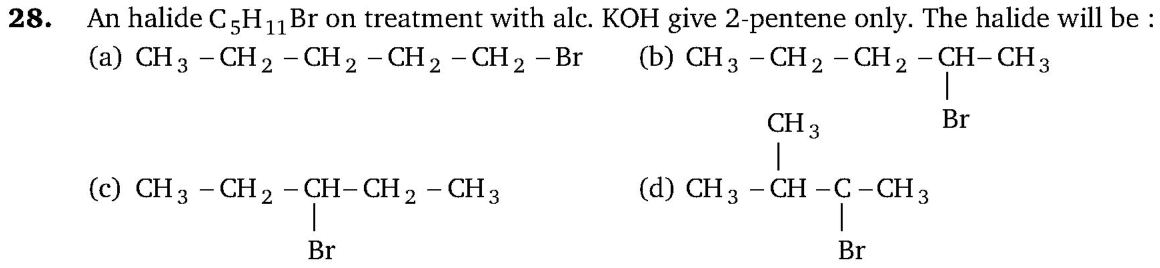
Concept: When an alkyl halide undergoes elimination with alcoholic KOH (E2), it follows Zaitsev's rule and gives the more substituted alkene as the major product. The question states that 2-pentene is the ONLY product formed, meaning there is no possibility of forming any other alkene. Step 1: Identify 2-pentene. 2-pentene is CH3-CH=CH-CH2-CH3, with the double bond between C2 and C3. Step 2: Analyze each option for possible elimination products. Option (a): 1-bromopentane (CH3CH2CH2CH2CH2Br). E2 elimination can only remove a beta-hydrogen from C2, giving 1-pentene (CH3CH2CH2CH=CH2). This gives 1-pentene, not 2-pentene. Eliminated. Option (b): 2-bromopentane (CH3CH2CH2CHBrCH3). E2 elimination can remove H from C1 (giving 1-pentene) or H from C3 (giving 2-pentene). Both products are possible. Since more than one alkene can form, it cannot give 2-pentene ONLY. Eliminated. Option (c): 3-bromopentane (CH3CH2CHBrCH2CH3). E2 elimination can remove H from C2 (giving 2-pentene) or H from C4 (giving 3-pentene? No - C4 removal gives CH3CH2CH=CHCH3 which is also 2-pentene by symmetry). Wait - 3-bromopentane is symmetric: C2 and C4 are equivalent, and C1 and C5 are equivalent. Removing H from C2 gives CH3-CH=CH-CH2-CH3 (2-pentene), and removing H from C4 gives CH3CH2CH=CHCH3 (also 2-pentene due to symmetry). There are no other beta-hydrogens that would give a different alkene since C2 and C4 give the same product. Therefore, the ONLY product is 2-pentene. This matches the condition perfectly. Option (d): 2-bromo-2-methylbutane or a neopentyl-type structure. This would give a branched alkene (methylbutene), not 2-pentene. Eliminated. Why option (c) is correct: 3-bromopentane is symmetric about C3. Both sets of beta-hydrogens (on C2 and C4) are equivalent by symmetry and both lead to the same product: 2-pentene (or equivalently written as pent-2-ene). There is no other possible elimination product, so 2-pentene is formed exclusively. Therefore, the correct answer is C.