See image — Isomerism and Stereochemistry Chemistry Question
Question
See image
💡 Solution & Explanation
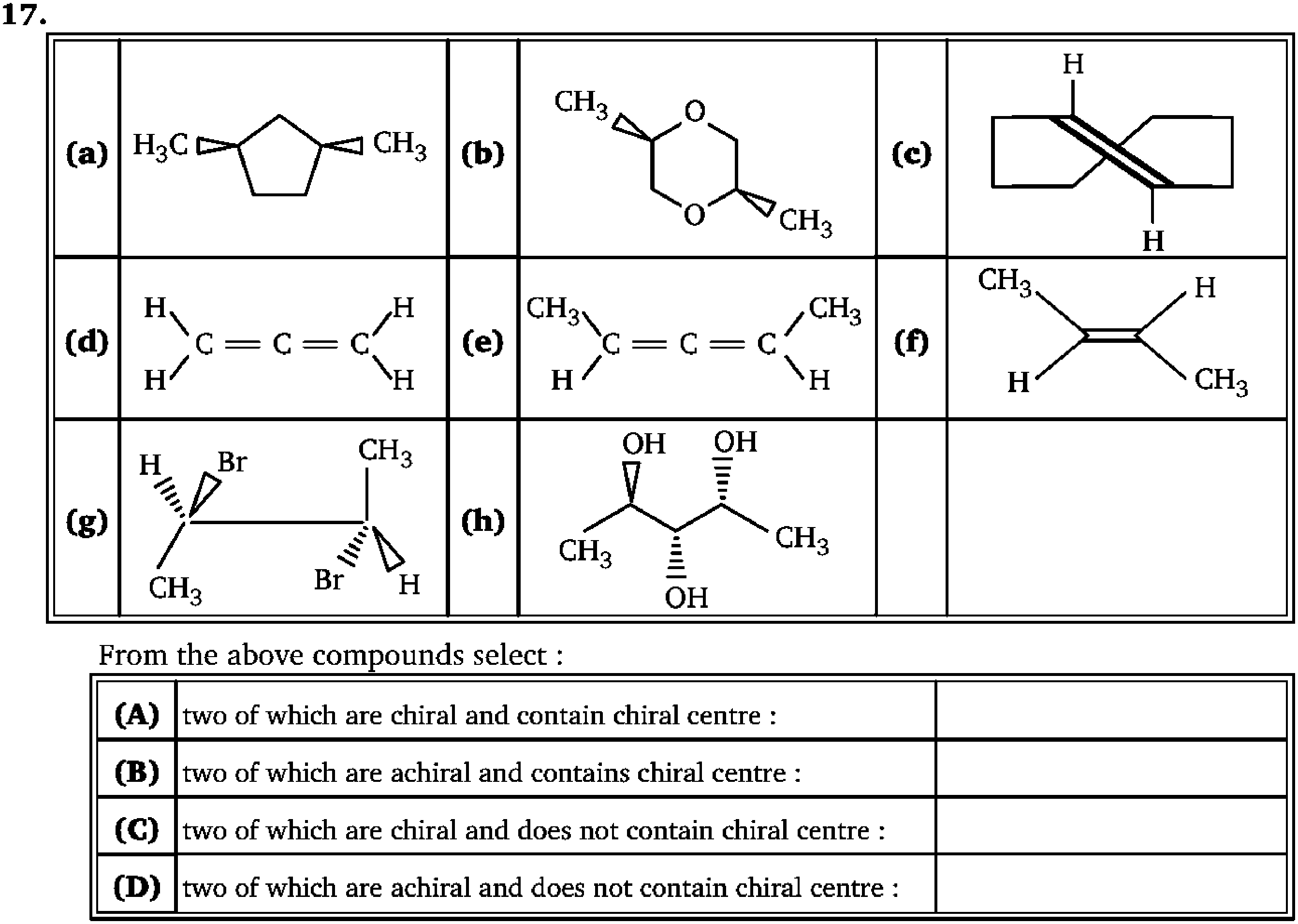
Step 1 - Classify each compound for chirality (overall molecule chiral or achiral) and presence of chiral centres (stereocentres): (a) 1,3-dimethylcyclopentane: The ring has two stereocentres at C1 and C3. As drawn (with the small wedge-like bonds suggesting a cis relationship), the cis isomer is a meso compound - it has chiral centres but an internal plane of symmetry making the molecule achiral overall. Therefore: ACHIRAL, HAS chiral centres. (b) 2,5-dimethyl-1,4-dioxane with epoxide rings at C2 and C5: Each carbon bearing the epoxide and methyl group is a stereocentre. As drawn with both epoxides on the same face, the molecule has two stereocentres but due to the specific configuration shown (C2 and C5 have the same configuration), there is no internal plane of symmetry, making the molecule chiral. Therefore: CHIRAL, HAS chiral centres. (c) Bicyclic compound with two cyclohexane rings connected by a double bond (spiro or bicyclic allenic/axially chiral system): This appears to be a bicyclic compound with a cumulated or bridging double bond creating axial chirality (similar to allenic chirality in a ring system, e.g., 1,2-cyclohexadiene fused system or spiro compound). The H atoms shown on wedges indicate axial chirality. There are no sp3 stereocentres (no chiral carbon atoms), but the molecule is chiral due to axial/helical chirality. Therefore: CHIRAL, NO chiral centres. (d) Propadiene (allene, H2C=C=CH2): Both terminal carbons bear two identical substituents (H,H). The molecule has a plane of symmetry and is achiral. No chiral centres (the central sp carbon is not a stereocentre in the classical sense). Therefore: ACHIRAL, NO chiral centres. (e) 1,3-dimethylallene (CH3(H)C=C=C(H)CH3): In allenes, chirality arises when each terminal carbon bears two different substituents. Here each terminal carbon has CH3 and H - two different groups - so the allene is axially chiral. The specific configuration shown makes it chiral. No classical sp3 chiral centres. Therefore: CHIRAL, NO chiral centres. (f) (E)-2-butene or (Z)-2-butene: CH3 and H on each end of the double bond. The molecule has a plane of symmetry (it is (E)-2-butene based on the arrangement shown with CH3 and H on opposite sides, or (Z) on same side). Either way, it is achiral and has no chiral centres (sp2 carbons are not chiral centres). Therefore: ACHIRAL, NO chiral centres. (g) 2,3-dibromobutane with the stereochemistry shown: Two stereocentres at C2 and C3. The wedge-dash drawing shows a specific configuration. If the two stereocentres have opposite configurations (one R, one S) and the molecule is superimposable on its mirror image, it is meso (achiral). The drawing with Br and H wedge/dash arrangement indicates the (2R,3S) or meso form. Therefore: ACHIRAL, HAS chiral centres. (h) Pentane-2,3,4-triol with OH at C2 wedge up, OH at C3 dash down, OH at C4 wedge up: Three stereocentres. The molecule is not a meso compound given this configuration - the arrangement of OH groups (up, down, up) does not create an internal mirror plane because C2 and C4 have the same configuration while C3 differs, but the overall molecule lacks an internal plane of symmetry with this arrangement (unlike the meso form which would have up, down, up in a symmetric way). Actually examining: C2 (OH up, CH3 down) and C4 (OH up, CH3 down on right side) - the molecule as drawn is chiral. Therefore: CHIRAL, HAS chiral centres. Step 2 - Categorize: (A) Chiral AND has chiral centres: (b) and (h) (B) Achiral AND has chiral centres: (a) and (g) [meso compounds] (C) Chiral AND no chiral centres: (c) and (e) [axial chirality] (D) Achiral AND no chiral centres: (d) and (f) Step 3 - Verify against given answer: A-b,h; B-a,g; C-c,e; D-d,f. This matches perfectly. Therefore, the correct answer is A-b,h; B-a,g; C-c,e; D-d,f.