See image — Aromatic Hydrocarbons Chemistry Question
Question
See image
💡 Solution & Explanation
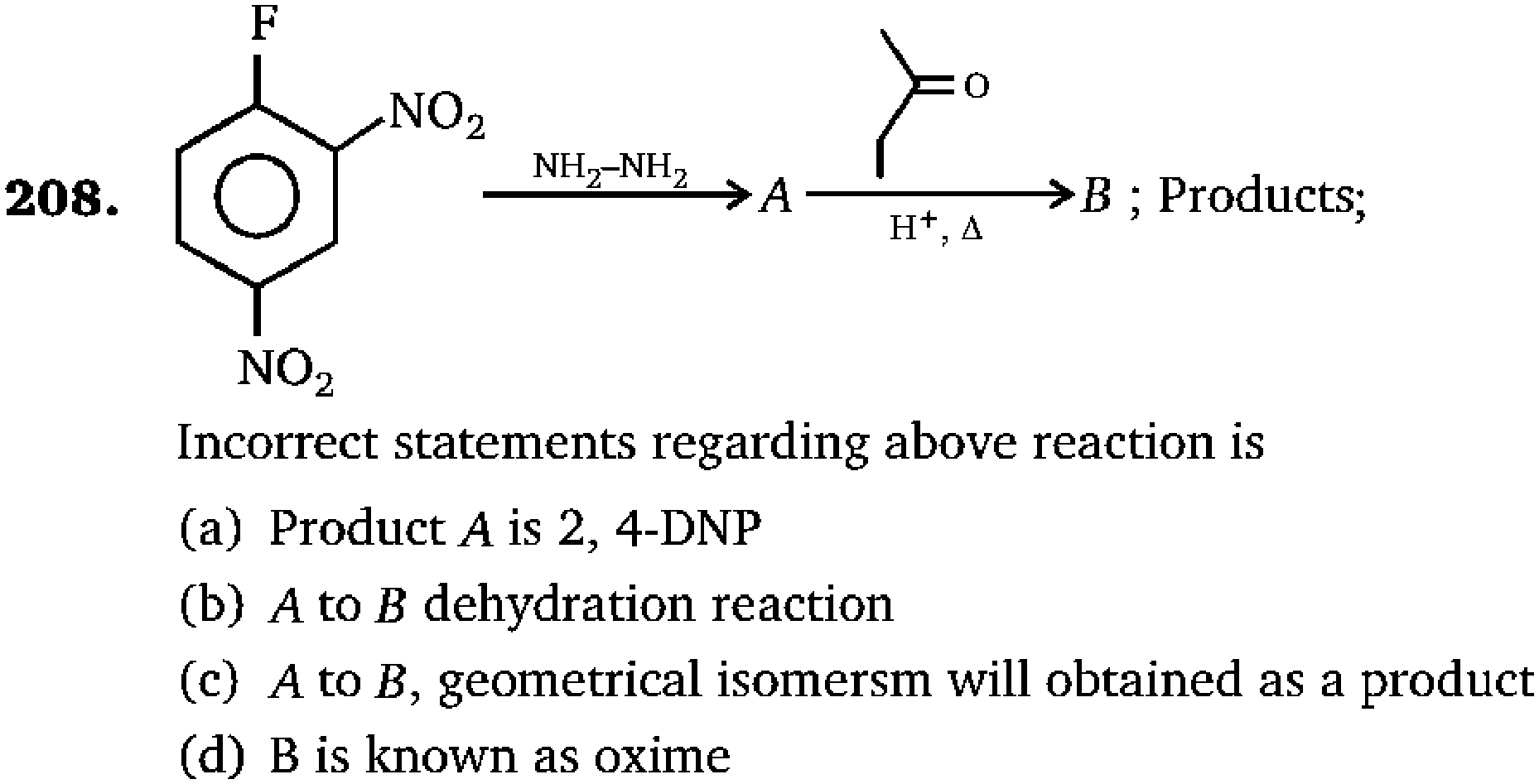
Step 1 - Identify the starting material and reagent: The starting material is 1-fluoro-2,4-dinitrobenzene (2,4-dinitrochlorofluorobenzene analog, specifically 2,4-dinitrofluorobenzene). It reacts with hydrazine (NH2-NH2) via nucleophilic aromatic substitution (SNAr), where the fluorine (activated by the two ortho/para nitro groups) is displaced by the -NH-NH2 group, giving 2,4-dinitrophenylhydrazine (2,4-DNP). So product A is 2,4-DNP. Statement (a) is CORRECT. Step 2 - Reaction of A with the ketone: 2,4-DNP (product A) reacts with methyl ethyl ketone (CH3COCH2CH3) under acidic conditions with heat. This is the classic 2,4-DNP test for carbonyl compounds. The -NH-NH2 group of 2,4-DNP reacts with the carbonyl of the ketone via condensation (addition-elimination), losing water (H2O) to form a hydrazone (2,4-dinitrophenylhydrazone). Statement (b) says A to B is a dehydration reaction - this is CORRECT because water is lost in forming the C=N bond. Step 3 - Geometrical isomerism: The product B is R-CH=N-NH-Ar (a hydrazone), where R groups on C are different (CH3 and CH2CH3). The C=N double bond in hydrazones can exhibit E/Z (geometrical) isomerism. Statement (c) is CORRECT. Step 4 - Naming of product B: Product B is a 2,4-dinitrophenylhydrazone. An oxime is formed when a carbonyl compound reacts with hydroxylamine (NH2OH), giving R2C=N-OH. Since A is 2,4-DNP (a hydrazine derivative, not hydroxylamine), product B is a hydrazone, NOT an oxime. Statement (d) is INCORRECT. Therefore, the correct answer is D.