See image — Hydrocarbons Chemistry Question
Question
See image
💡 Solution & Explanation
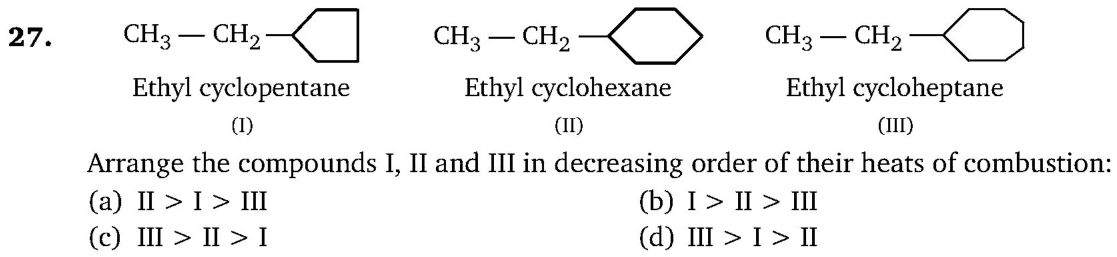
Concept: The heat of combustion of a compound increases with the number of carbon atoms (and hence molecular weight/number of C-H and C-C bonds that can be oxidized). Additionally, ring strain contributes to higher energy content and thus higher heat of combustion. Step 1: Count the total number of carbon atoms in each compound. - Ethyl cyclopentane (I): cyclopentane ring (5 C) + ethyl group (2 C) = 7 carbons total (C7H14) - Ethyl cyclohexane (II): cyclohexane ring (6 C) + ethyl group (2 C) = 8 carbons total (C8H16) - Ethyl cycloheptane (III): cycloheptane ring (7 C) + ethyl group (2 C) = 9 carbons total (C9H18) Step 2: The heat of combustion is primarily determined by the number of carbon and hydrogen atoms. More carbons and hydrogens mean more bonds oxidized and more energy released. - III (C9H18) has the most carbons, so it releases the most heat. - II (C8H16) has the second most carbons. - I (C7H14) has the fewest carbons, releasing the least heat. Step 3: Consider ring strain contributions. Cyclopentane has moderate ring strain, cyclohexane has essentially no ring strain (chair conformation), and cycloheptane has moderate ring strain. Ring strain adds to the internal energy of the molecule, slightly increasing heat of combustion. However, the dominant factor is the number of carbons (molecular size). The ordering by carbon count gives III > II > I. Step 4: Even accounting for ring strain corrections, the number of carbons dominates. III > II > I in heat of combustion. Why other options fail: - (a) II > I > III: Ignores the greater number of carbons in III. - (b) I > II > III: Reverses the correct order entirely. - (d) III > I > II: Incorrectly places I above II, despite II having more carbons. Therefore, the correct answer is C.