See image — Hydrocarbons Chemistry Question
Question
See image
💡 Solution & Explanation
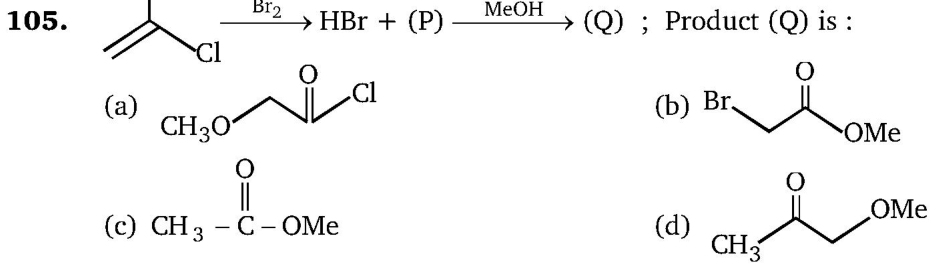
Step 1 - Identify the starting material: The starting material is 2-chloro-1-methylenepropene, which can be written as CH2=C(Cl)-CH3... but looking more carefully at the structure drawn, it shows CH2=C with Cl on the carbon bearing the double bond and a methyl group - actually the structure is CH2=CCl-... wait, re-examining: the structure is a vinyl chloride-type compound. The image shows a terminal alkene: the carbon bearing Cl also has a =CH2 group. So the compound is CH2=C(Cl)-... but there is also what appears to be a methylene. Let me re-read: the structure appears to be 2-chloro-1-methylenepropene or more precisely CH2=C(CH2?)-Cl. Actually from the image it is 2-chloro-1-propene-type: the structure is CH2=C(Cl)-CH3? No. Looking at the drawn structure: there is a carbon with a double bond to CH2, and also bonded to Cl, with what looks like a methyl or CH2. The compound drawn is likely CH2=CCl-CH3 (2-chloropropene) or CH2=C(CH2Cl) something. Given the answer is B (methyl bromoacetate, BrCH2COOMe), let me work backward. Step 2 - The reaction sequence: Starting alkene + Br2 → HBr + (P). This is a special reaction. The starting material appears to be CH2=C(Cl)-... The addition of Br2 to a vinyl chloride type compound can proceed with elimination of HBr. If the starting material is CH2=CCl2 or similar, Br2 adds and then HBr is eliminated. More likely, the structure is CH2=C(Cl)-something that upon treatment with Br2 undergoes addition then rearrangement/elimination to give HBr + (P) where P contains a Br and a carbonyl (since MeOH converts it to an ester). Step 3 - If P is BrCH2-C(=O)-Cl (bromoacetyl chloride), then reaction with MeOH would give BrCH2-C(=O)-OMe (methyl bromoacetate), which is answer (b). Step 4 - The starting material CH2=CCl-CH2Cl or more likely the structure is 2,3-dichloropropene or similar. Actually the most consistent interpretation: the starting material is CH2=C(Cl)-CH2Cl (2,3-dichloro-1-propene... no). Given the image shows a terminal methylene (CH2=) connected to a carbon bearing Cl and another substituent, and Br2 gives HBr + P, then P + MeOH gives methyl bromoacetate: If starting material is CH2=C(Cl)- with an additional CH2 group making it CH2=CCl-CH2... The most logical pathway: CH2=CCl2 + Br2 → CH2Br-CCl2Br → -HBr → CHBr=CCl2 or alternatively the compound is a ketene equivalent. The key is P must be BrCH2COCl (bromoacetyl chloride) because BrCH2COCl + MeOH → BrCH2COOMe + HCl, giving product Q = methyl bromoacetate (option b). Step 5 - Why other options fail: (a) would require no Br incorporation in product; (c) methyl acetate has no Br and doesn't account for Br2; (d) has no Br and wrong connectivity. Therefore, the correct answer is B.