See image — Alcohols Phenols and Ethers Chemistry Question
Question
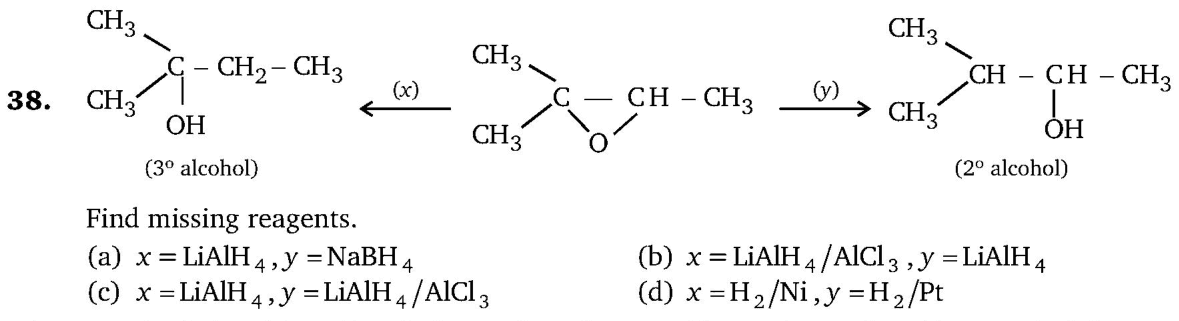
See image
💡 Solution & Explanation
Concept: Ring-opening of epoxides by hydride reducing agents can proceed via different mechanisms depending on the reagent used, leading to different regiochemical outcomes (Markovnikov vs. anti-Markovnikov). The starting material is an unsymmetrical epoxide: (CH3)2C-epoxide-CHCH3, i.e., 2,2-dimethyl-3-methyloxirane (or equivalently, 2-methyl-2,3-epoxibutane, but with two methyls on one carbon). Step 1 - Reaction (x): The epoxide reacts to give a tertiary alcohol: (CH3)2C(OH)-CH2-CH3. Wait, let me re-examine the structures. The product on the left is (CH3)2C(OH)-CH2-CH3, which is a 3° alcohol. This means the OH is on the more substituted carbon (tertiary carbon), and the other carbon gained a hydrogen. This is the anti-Markovnikov-like opening (nucleophile attacks less hindered carbon under acidic/Lewis acid conditions). Actually, in acid-catalyzed epoxide opening, the nucleophile (hydride) attacks the MORE substituted carbon. LiAlH4 alone (SN2 mechanism) opens epoxides at the LESS hindered carbon. LiAlH4/AlCl3 acts as a Lewis acid catalyst, promoting carbocation-like opening at the MORE substituted carbon. For reaction x: The product has OH on the tertiary carbon, meaning hydride was delivered to the more substituted carbon. This requires Lewis acid activation: LiAlH4/AlCl3 would give this. But wait, the answer is c: x = LiAlH4, y = LiAlH4/AlCl3. Let me re-examine. The left product (3° alcohol) is (CH3)2C(OH)-CH2CH3: OH is on the quaternary-like carbon (2 methyls + ethyl + OH = tertiary). The epoxide carbon bearing two methyls is the more substituted carbon. Under LiAlH4 (SN2, no acid), hydride attacks the LESS hindered carbon (the CH-CH3 end), delivering H to CH-CH3, giving OH on C(CH3)2. That means OH ends up on the more substituted carbon. So plain LiAlH4 (SN2) attacks less hindered carbon (CH side), protonation gives OH on the gem-dimethyl carbon = tertiary alcohol. This is consistent with x = LiAlH4. Step 2 - Reaction (y): The epoxide reacts to give a secondary alcohol: (CH3)2CH-CH(OH)-CH3. Here OH is on the less substituted carbon (secondary), meaning hydride was delivered to the less substituted carbon... actually the CH(OH) position. The gem-dimethyl carbon becomes CH(CH3)2 (isopropyl), meaning the C(CH3)2 of the epoxide received H. This is attack at the MORE substituted carbon, which requires Lewis acid (LiAlH4/AlCl3) to generate partial carbocation character at the more substituted carbon, but actually in acid conditions hydride from AlH4- attacks the more substituted position. If hydride attacks C(CH3)2 (more substituted), then OH ends up on CH-CH3 (less substituted) = secondary alcohol. This is consistent with Lewis acid-catalyzed opening: y = LiAlH4/AlCl3. Summary: x = LiAlH4 (SN2, attacks less hindered CH end, giving 3° alcohol on gem-dimethyl carbon), y = LiAlH4/AlCl3 (Lewis acid, attacks more hindered gem-dimethyl carbon, giving 2° alcohol on CH-CH3 carbon). This matches option (c). Why other options fail: - (a) NaBH4 does not typically open epoxides efficiently, and assignment is wrong. - (b) Reverses the reagents: LiAlH4/AlCl3 for x would give 2° alcohol not 3°, and plain LiAlH4 for y would give 3° alcohol not 2°. - (d) H2/Ni and H2/Pt are hydrogenation catalysts, not used for epoxide ring-opening to give alcohols. Therefore, the correct answer is C.