See image — Hydrocarbons Chemistry Question
Question
See image
💡 Solution & Explanation
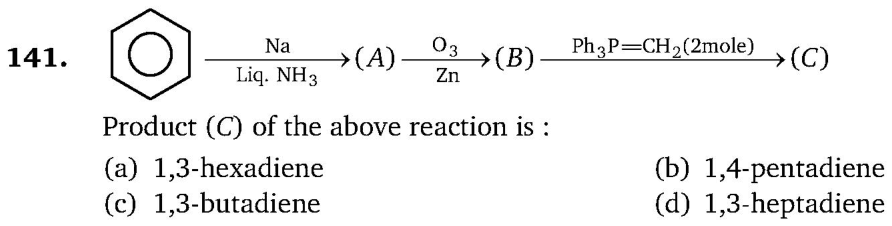
Step 1: Birch Reduction of Benzene. Benzene treated with Na in liquid NH3 (Birch reduction) gives 1,4-cyclohexadiene (compound A). The double bonds remain at positions 1 and 4, with the reduced carbons at positions 2,3 and 5,6 (actually the product is 1,4-cyclohexadiene, where C1-C2 and C4-C5 are double bonds, i.e., cyclohexa-2,5-dien-1... more precisely, Birch reduction of benzene yields 1,4-cyclohexadiene). Step 2: Ozonolysis of 1,4-cyclohexadiene with O3/Zn (reductive workup). 1,4-cyclohexadiene has two double bonds. Ozonolysis cleaves both double bonds. The ring opens and each double bond is cleaved to give two aldehyde groups. 1,4-cyclohexadiene (double bonds at C1-C2 and C4-C5) upon ozonolysis gives OHC-CH2-CH2-CHO (succinaldehyde, butanedial) — wait, let me reconsider. 1,4-cyclohexadiene has the structure with double bonds between C1-C2 and C4-C5. Ozonolysis of both double bonds cleaves the ring: C1=C2 gives CHO at C1 and CHO at C2; C4=C5 gives CHO at C4 and CHO at C5. The resulting open-chain compound is OHC-CH2-CHO connected via CH2-CH2... The product is: OHC-CH2-CH2-CHO (succinaldehyde) — actually the cleavage of a 6-membered ring with two double bonds at 1,2 and 4,5 positions gives OHC-CH2-CHO and another fragment, but since it's cyclic, cleavage of both gives one open-chain dialdehyde: OHC-CH2-CHO...No. For cyclic 1,4-cyclohexadiene (double bonds C1=C2 and C4=C5), ozonolysis cleaves both to give: CHO-CH2-CH2-CHO (from C3-C4 and C6-C1 carbons connecting), giving butanedial (succinaldehyde, 4 carbons). Actually the product is OHC-(CH2)2-CHO — but wait, the ring has 6 carbons: C1=C2-C3-C4=C5-C6-C1. Cleavage of C1=C2 and C4=C5 gives: OHC-C3H2-CHO (malonaldehyde portion) and OHC-C6H2-CHO (another malonaldehyde)... No, since it's cyclic, both cleavages on the same ring give one open-chain compound: OHC-CH2-CHO + OHC-CH2-CHO — no. The ring opens to give a single chain: OHC-CH2-CHO-CH2-CHO — this isn't right either. The correct product: 6-membered ring with bonds cut at C1-C2 and C4-C5 gives the chain: C2(CHO)-C3H2-C4(CHO)...and C5(CHO)-C6H2-C1(CHO), but since cyclic, it's one molecule: OHC-CH2-CHO and the other part recombines as OHC-CH2-CHO — i.e., two molecules of malonaldehyde. So compound B = OHC-CH2-CHO (malonaldehyde, propanedial). Step 3: Wittig reaction with 2 moles of Ph3P=CH2 (methylenation). Each CHO group reacts with one mole of Ph3P=CH2 to replace C=O with C=CH2. So OHC-CH2-CHO becomes CH2=CH-CH2-CH=CH2, which is 1,4-pentadiene. This matches option (b) 1,4-pentadiene. Why other options fail: 1,3-hexadiene (a) would require a 6-carbon product; 1,3-butadiene (c) would require a 2-carbon dialdehyde precursor; 1,3-heptadiene (d) requires 7 carbons. The Wittig on malonaldehyde gives a 5-carbon 1,4-diene, not a conjugated diene. Therefore, the correct answer is B.