See image — Reaction Mechanism Chemistry Question
Question
See image
💡 Solution & Explanation
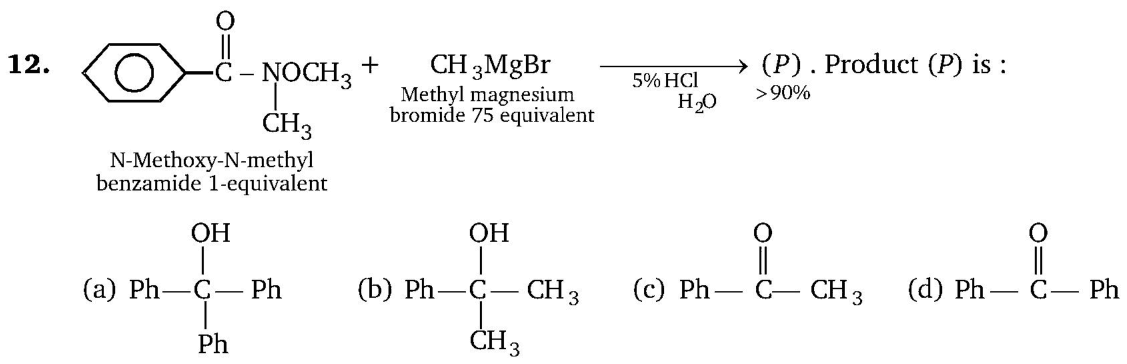
Concept: Weinreb amides (N-methoxy-N-methylamides) react with Grignard reagents to give ketones upon workup, because the tetrahedral intermediate is stabilized by chelation with the nitrogen's methoxy group, preventing over-addition under controlled conditions. However, with a large excess (75 equivalents) of CH3MgBr, the initially formed ketone (acetophenone, product of normal Weinreb amide reaction) can undergo a second addition of the Grignard reagent. Step 1: The Weinreb amide (N-methoxy-N-methylbenzamide) reacts with CH3MgBr. Normally, one equivalent of Grignard adds to the Weinreb amide to give, after aqueous workup, acetophenone (Ph-CO-CH3). The Weinreb amide is designed to stop at the ketone stage under normal (1 equiv) conditions because the magnesium chelate stabilizes the tetrahedral intermediate. Step 2: However, in this reaction, 75 equivalents of CH3MgBr are used. With such a large excess, the ketone intermediate (acetophenone) formed in situ does not accumulate — instead, the excess Grignard immediately adds to the ketone before workup. CH3MgBr adds to Ph-CO-CH3 to give Ph-C(OMgBr)(CH3)(CH3), i.e. the magnesium alkoxide of 2-phenyl-2-propanol. Step 3: Upon acidic aqueous workup (5% HCl, H2O), the alkoxide is protonated to give Ph-C(OH)(CH3)2, which is 2-phenyl-2-propanol (shown as Ph-C(OH)(CH3)-CH3 with two methyl groups on the same carbon bearing OH). Why other options fail: - Option (a): Triphenylmethanol would require PhMgBr and two additions; CH3MgBr cannot produce Ph groups. - Option (c): Acetophenone would be the product with exactly 1 equivalent of Grignard and normal Weinreb conditions, but the 75-equivalent excess drives a second addition. - Option (d): Benzophenone would require a phenyl Grignard reagent. Option (b) Ph-C(OH)(CH3)2 (2-phenyl-2-propanol) is the product of double addition of CH3MgBr: first to the Weinreb amide giving acetophenone intermediate, then second addition of CH3MgBr to acetophenone, followed by hydrolysis. Therefore, the correct answer is B.