See image — Biomolecules Chemistry Question
Question
See image
💡 Solution & Explanation
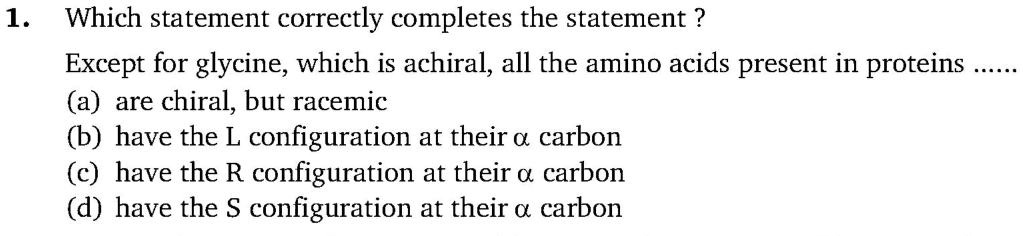
Concept: Amino acids found in proteins are stereochemically specific. With the exception of glycine (which has two hydrogen atoms on its alpha carbon and is therefore achiral/symmetric), all naturally occurring amino acids in proteins are chiral at their alpha carbon. Reasoning: The amino acids incorporated into proteins by ribosomes are exclusively of the L-configuration. The L/D nomenclature is based on the Fischer projection convention, comparing the spatial arrangement of groups around the alpha carbon to L- and D-glyceraldehyde. All proteinogenic amino acids (except glycine) possess the L-configuration at the alpha carbon. Why other options fail: - Option (a): They are chiral, but they are NOT racemic. A racemic mixture contains equal amounts of both L and D enantiomers, but proteins contain only L-amino acids. - Option (c): The R configuration does not uniformly describe proteinogenic amino acids. Most L-amino acids have S configuration by CIP rules, but a few exceptions exist (e.g., cysteine is R due to sulfur's high priority). Therefore, R configuration is not the correct general descriptor. - Option (d): While most L-amino acids do have the S configuration by CIP rules, this is not universally true for all proteinogenic amino acids (cysteine is L but R by CIP). The classical and universally correct descriptor for all proteinogenic amino acids is L-configuration, not S. The L-configuration is the historically established and universally applicable descriptor for all amino acids found in proteins (except glycine). Therefore, the correct answer is B.