See image — IUPAC and Nomenclature Chemistry Question
Question
See image
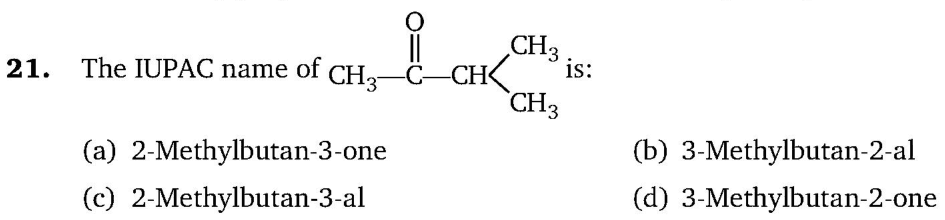
💡 Solution & Explanation
Step 1: Identify the structure. The compound is CH3-C(=O)-CH(CH3)2. It consists of a methyl group (CH3), a carbonyl group (C=O), and an isopropyl group (CH(CH3)2). Step 2: Identify the principal functional group. The C=O group with no hydrogen attached (ketone, -one suffix) is the principal functional group. Step 3: Count the total carbon chain including the ketone carbon. We have: CH3 (C1) - C=O (C2) - CH (C3) - with two CH3 branches at C3. Wait, let me re-examine: The structure is CH3-C(=O)-CH(CH3)(CH3). The longest chain containing the ketone: C1(CH3)-C2(=O)-C3(CH(CH3)2). The CH at position 3 has two methyl groups, making the longest chain 4 carbons: CH3-C(=O)-CH(CH3)-CH3, which is a 4-carbon chain (butanone), with a methyl branch. Step 4: Number the chain to give the carbonyl group the lowest locant. Numbering from the CH3 end closest to C=O: C1=CH3, C2=C=O, C3=CH, C4=CH3. The other CH3 on C3 is a branch (methyl substituent). Step 5: The parent chain is butane (4 carbons), with a ketone at C2 (butan-2-one) and a methyl substituent at C3 (3-methyl). Step 6: Full IUPAC name = 3-Methylbutan-2-one. Step 7: Why other options fail: - (a) 2-Methylbutan-3-one: This would place the ketone at C3 and methyl at C2, but numbering should give the carbonyl the lowest number (C2 not C3). - (b) 3-Methylbutan-2-al: 'al' suffix indicates an aldehyde, but the compound has a ketone (no H on carbonyl carbon). - (c) 2-Methylbutan-3-al: Incorrect suffix (aldehyde) and incorrect numbering. Therefore, the correct answer is D.