See image — Hydrocarbons Chemistry Question
Question
See image
💡 Solution & Explanation
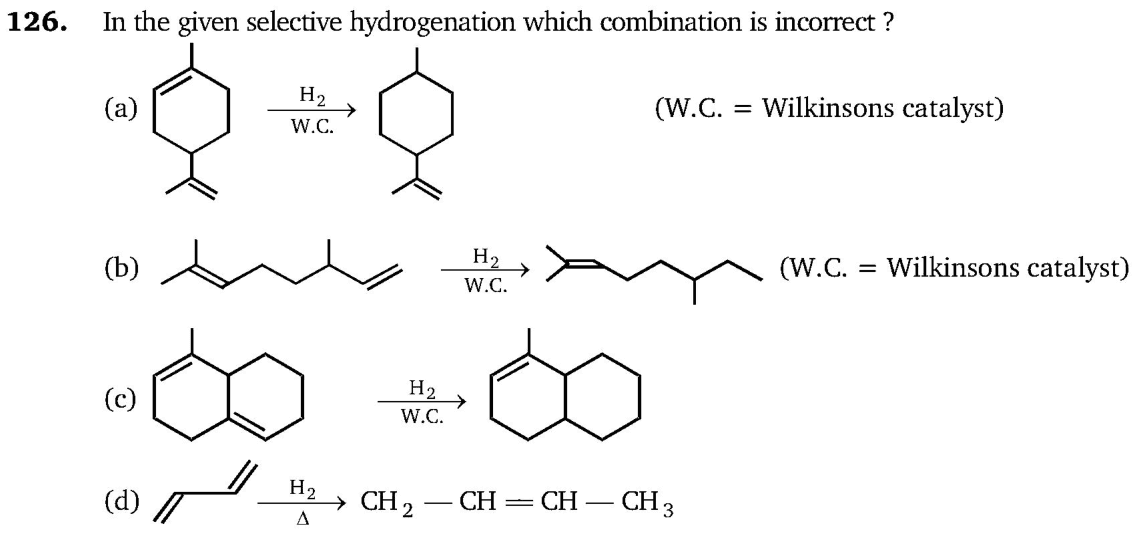
Concept: Wilkinson's catalyst [RhCl(PPh3)3] is a homogeneous hydrogenation catalyst that selectively hydrogenates less hindered (less substituted) double bonds over more substituted ones. It is also known to preferentially hydrogenate isolated alkenes over conjugated or sterically hindered ones. Step 1 – Analyze option (a): The starting material has two double bonds: one endocyclic (trisubstituted, inside the cyclohexene ring) and one exocyclic terminal vinyl/isopropenyl group (=CH2, less substituted). Wilkinson's catalyst preferentially hydrogenates the LESS hindered (less substituted) double bond. The exocyclic =CH2 (terminal, monosubstituted) is less hindered than the trisubstituted endocyclic double bond. Therefore, Wilkinson's catalyst should hydrogenate the exocyclic terminal double bond first, NOT the endocyclic one. However, option (a) shows the endocyclic double bond being hydrogenated (ring becomes cyclohexane) while the exocyclic =CH2 remains. This is INCORRECT because W.C. should preferentially reduce the less substituted exocyclic alkene, not the more substituted endocyclic one. Step 2 – Analyze option (b): The diene has a trisubstituted alkene and a monosubstituted (terminal) alkene. W.C. selectively hydrogenates the less hindered terminal alkene, leaving the trisubstituted one intact. The product shown reflects hydrogenation of the less substituted alkene. This is CORRECT behavior for Wilkinson's catalyst. Step 3 – Analyze option (c): The bicyclic substrate has a more substituted (conjugated/aromatic-adjacent) double bond and a less substituted isolated double bond. W.C. hydrogenates the less hindered isolated double bond preferentially. The product shown is consistent with selective hydrogenation of the less substituted double bond. This is CORRECT. Step 4 – Analyze option (d): 1,3-Butadiene undergoing partial hydrogenation with H2/heat (not Wilkinson's catalyst) to give but-2-ene (internal alkene) or but-1-ene is a known reaction (Lindlar or semi-hydrogenation conditions). This is a correct and known transformation. Conclusion: Option (a) is incorrect because Wilkinson's catalyst is selective for less hindered alkenes, so it should reduce the exocyclic terminal =CH2 group, not the more substituted endocyclic double bond as shown. Therefore, the correct answer is A.