See image — Alcohols Phenols and Ethers Chemistry Question
Question
See image
💡 Solution & Explanation
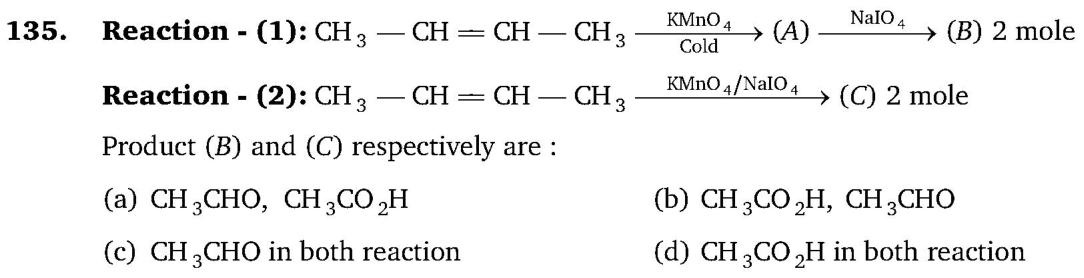
Concept: Cold dilute KMnO4 (Baeyer's reagent) causes syn-dihydroxylation of alkenes to give vicinal diols. NaIO4 cleaves vicinal diols (periodate cleavage) oxidatively. KMnO4/NaIO4 together perform oxidative cleavage directly, where the products are ketones or carboxylic acids depending on substitution. Step 1 - Reaction (1): CH3-CH=CH-CH3 treated with cold KMnO4 gives the vicinal diol (A): CH3-CH(OH)-CH(OH)-CH3 (meso or racemic 2,3-butanediol). Then NaIO4 cleaves the diol: each carbon of the C-C bond that bore the OH group becomes an aldehyde or ketone. Since both carbons are secondary (each bears one H and one CH3), the cleavage gives two molecules of CH3CHO (acetaldehyde). So product B = CH3CHO (2 moles). Step 2 - Reaction (2): CH3-CH=CH-CH3 treated with KMnO4/NaIO4 (hot, acidic, or combined oxidative cleavage conditions). Under these conditions, the cleavage is more oxidizing: secondary carbons that would give aldehydes are further oxidized to carboxylic acids. Each CH3-CH= carbon is secondary (has one H), so it is oxidized all the way to CH3CO2H (acetic acid). So product C = CH3CO2H (2 moles). Step 3 - Distinguishing the two reactions: Reaction (1): Cold KMnO4 gives diol, then mild NaIO4 cleavage stops at aldehyde stage → B = CH3CHO. Reaction (2): KMnO4/NaIO4 under more vigorous (oxidative) conditions oxidizes the aldehyde intermediate further to carboxylic acid → C = CH3CO2H. Why other options fail: (b) reverses B and C incorrectly. (c) says both give CH3CHO, ignoring that KMnO4/NaIO4 oxidizes to acid. (d) says both give CH3CO2H, ignoring that mild NaIO4 cleavage of the diol stops at aldehyde. Therefore, the correct answer is A.