See image — Biomolecules Chemistry Question
Question
See image
💡 Solution & Explanation
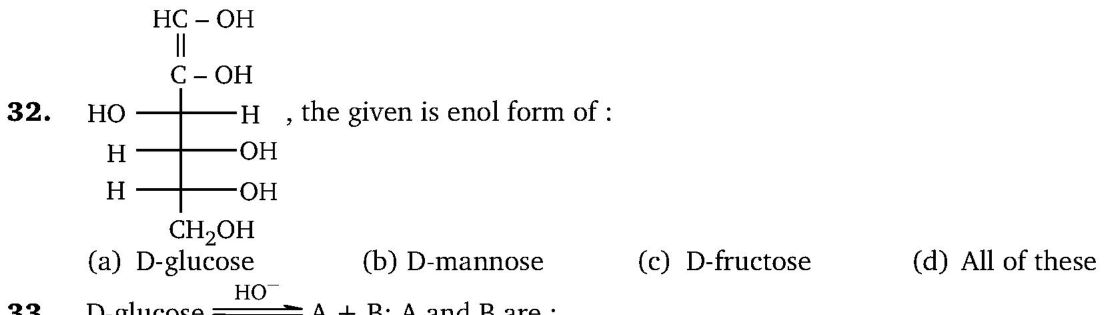
Concept: In alkaline conditions, glucose, mannose, and fructose are interconverted via a common enediol intermediate (Lobry de Bruyn–Alberda van Ekenstein rearrangement). Step 1: Identify the structure. The given structure is a 1,2-enediol of a hexose sugar. It has a C=C double bond between C1 and C2, with OH groups on both C1 and C2, making it an enediol (enol form). Step 2: Recognize what sugars share this enediol. D-Glucose (aldohexose with CHO at C1), D-Mannose (C2 epimer of glucose, aldohexose with CHO at C1), and D-Fructose (2-ketohexose with C=O at C2) all share the same 1,2-enediol intermediate when treated with base. The stereocenters at C3, C4, C5 are identical in all three: C3 has HO on left (S configuration), C4 has OH on right, C5 has OH on right, and C6 is CH2OH. Step 3: The enol form shown (1,2-enediol) is the common intermediate for D-glucose, D-mannose, and D-fructose. Tautomerization of this enediol can yield any of these three sugars depending on which carbon the proton is added to and on which face. Step 4: Why options (a), (b), and (c) individually are insufficient: The enediol intermediate is not exclusive to any single sugar — it is shared by all three. Therefore, saying it is only the enol form of glucose, or only mannose, or only fructose would be incomplete. Step 5: Since the given enediol is the enol form of D-glucose, D-mannose, AND D-fructose, the answer must be 'All of these'. Therefore, the correct answer is D.