See image — Aldehydes Ketones and Carboxylic Acids Chemistry Question
Question
See image
💡 Solution & Explanation
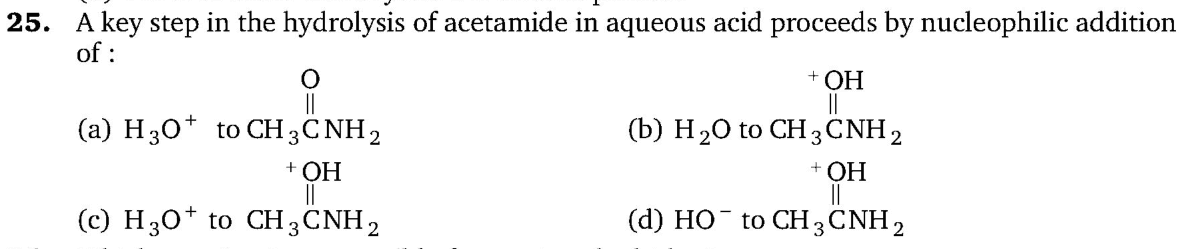
Concept: Hydrolysis of amides under acidic conditions proceeds through a specific mechanistic pathway involving protonation followed by nucleophilic addition. Step 1 - Protonation of the carbonyl oxygen: In aqueous acid, the carbonyl oxygen of acetamide (CH3C(=O)NH2) is first protonated by H3O+ to give the oxocarbenium/iminium intermediate CH3C(=+OH)NH2. This activation makes the carbonyl carbon more electrophilic. Step 2 - Nucleophilic addition: The key step is the nucleophilic addition of water (H2O) to this protonated (activated) form of acetamide, i.e., to CH3C(=+OH)NH2. Water acts as the nucleophile and attacks the electrophilic carbonyl carbon of the protonated species. Step 3 - Why other options fail: - Option (a): H3O+ is an electrophile/acid, not a nucleophile; it cannot perform nucleophilic addition. - Option (c): H3O+ acting on the protonated form is again electrophilic, not nucleophilic. - Option (d): HO- (hydroxide) is a nucleophile, but the hydrolysis is occurring under acidic conditions, not basic conditions; hydroxide is not the relevant nucleophile here. Step 4 - Conclusion: The nucleophile is H2O and it adds to the protonated acetamide (CH3C(=+OH)NH2), which is option (b). Therefore, the correct answer is B.