See image — Haloalkanes and Haloarenes Chemistry Question
Question
See image
💡 Solution & Explanation
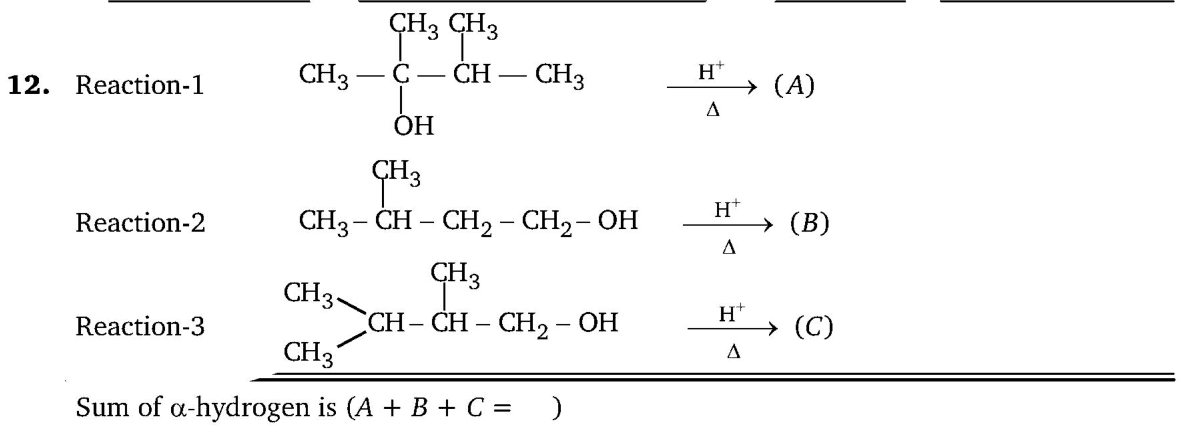
Concept: Under acid-catalyzed dehydration (H+/Delta), alcohols undergo E1 or E2 elimination. The major product follows Zaitsev's rule - the most substituted (most stable) alkene is the major product. The number of alpha-hydrogens refers to the hydrogens on the carbon alpha to the double bond in the major alkene product, which determines the number of alpha-H atoms on that product. Wait - re-reading the question: 'Sum of alpha-hydrogen' likely refers to the number of alpha-hydrogens available in the starting alcohol (i.e., hydrogens on carbons adjacent to the carbon bearing OH), which determines the possible alkene products. But given the answer is 33, let me reconsider. Actually, in the context of dehydration reactions, 'alpha-hydrogen' refers to the hydrogens on the carbon(s) adjacent to the OH-bearing carbon (beta carbons relative to OH, but alpha to the C-OH in elimination terminology). The question asks for alpha-hydrogens in products A, B, C. Re-interpreting: After dehydration, the major alkene product is formed. The alpha-hydrogens of the alkene product are the hydrogens on carbons adjacent to the double bond (allylic position). Reaction-1: Starting material is 2-methyl-3-methylbutan-2-ol: CH3-C(CH3)(OH)-CH(CH3)-CH3. This is 2,3-dimethylbutan-2-ol. Under H+/Delta, dehydration gives major product: 2,3-dimethylbut-2-ene (CH3)C=C(CH3)(CH3) via loss of H from C3. Product A = 2,3-dimethylbut-2-ene: (CH3)2C=C(CH3)- wait, structure: C1H3-C2(CH3)=C3(CH3)-C4H3. Alpha carbons to double bond are C1(3H) and C4(3H) and the methyl on C2(3H) and methyl on C3(3H). Allylic H = 3+3+3+3 = 12. But wait, the methyl groups directly on the double bond carbons are vinyl methyls, not allylic. Alpha-H to the double bond (on sp3 carbons adjacent to sp2): C1-CH3 gives 3H, and C4-CH3 gives 3H, plus the two extra methyls on C2 and C3 each give 3H. Total allylic H in A = 3+3+3+3 = 12. Reaction-2: 3-methylbutan-1-ol: CH3-CH(CH3)-CH2-CH2-OH. Dehydration via H+: carbocation at C1 -> rearrangement -> more stable carbocation. Primary OH loses water to give primary carbocation at C1, which rearranges via hydride shift to give tertiary carbocation at C3 (2-methylbutyl system). Actually: CH3-CH(CH3)-CH2-CH2-OH -> primary carbocation -> 1,2-hydride shift -> CH3-CH(CH3)-CH(+)-CH3 (tertiary) -> deprotonation gives CH3-C(CH3)=CH-CH3 (2-methylbut-2-ene) as major product B. Alpha-H (allylic) in 2-methylbut-2-ene (CH3-C(CH3)=CH-CH3): allylic carbons are the CH3 on C2 (3H), the CH3 on C4 (3H), and C5 methyl... Structure: C1H3-C2(CH3)=C3H-C4H3. Allylic H on C1 (3H) + allylic methyl on C2 (3H) + allylic H on C4 (3H) = 9. So B = 9. Reaction-3: 2,3-dimethylbutan-1-ol: (CH3)2CH-CH(CH3)-CH2-OH. Dehydration: primary OH, rearrangement likely. Carbocation at C1 rearranges: hydride shift from C2 gives tertiary carbocation at C2: (CH3)2C(+)-CH(CH3)-CH3 -> 2,3-dimethylbut-2-ene again? Or deprotonation gives (CH3)2C=C(CH3)-CH3... wait that's 2,3-dimethylbut-1-ene or 2-ene. Major product C = 2,3-dimethylbut-2-ene same as A, with 12 allylic H. A + B + C = 12 + 9 + 12 = 33. Therefore, the correct answer is 33.