See image — Alcohols Phenols and Ethers Chemistry Question
Question
See image
💡 Solution & Explanation
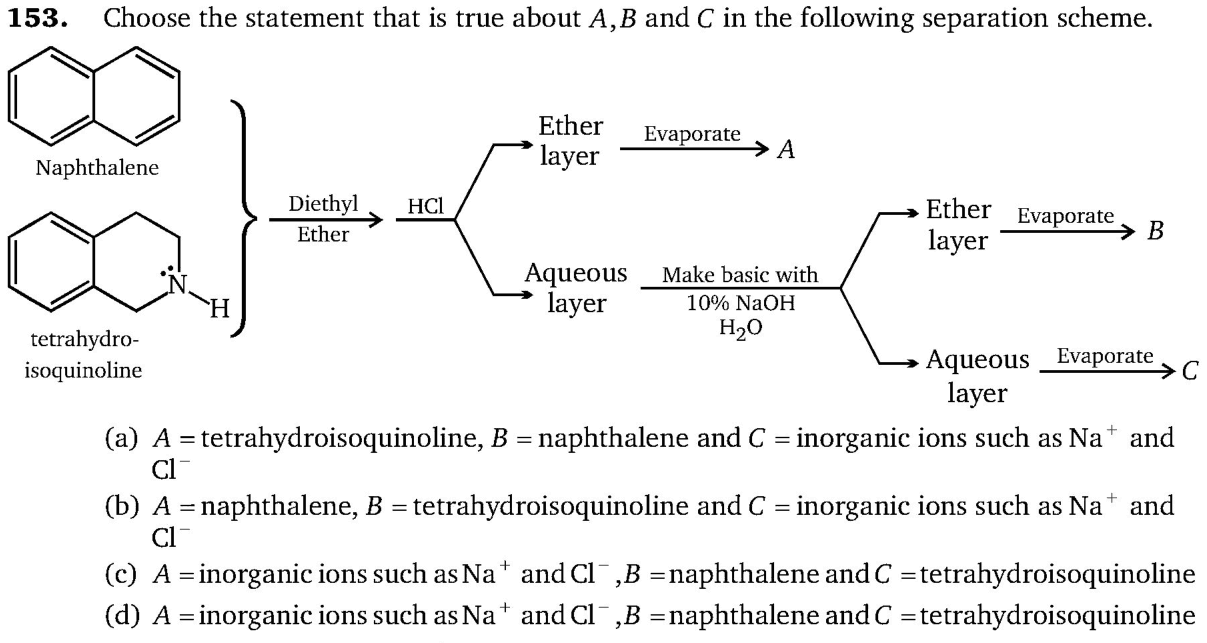
Step 1 - Identify the compounds and their properties: - Naphthalene is a neutral, nonpolar aromatic hydrocarbon. It is not basic and does not react with HCl. It remains in the ether (organic) layer. - Tetrahydroisoquinoline is a secondary amine (basic compound). It reacts with HCl to form a water-soluble ammonium salt (tetrahydroisoquinolinium chloride), which moves into the aqueous layer. Step 2 - After adding HCl and separating layers: - Ether layer contains: naphthalene (unreacted, stays in organic layer). - Aqueous layer contains: tetrahydroisoquinolinium chloride (the protonated amine salt). - Evaporating the ether layer gives A = naphthalene. Step 3 - Treatment of aqueous layer with 10% NaOH: - NaOH deprotonates the ammonium salt, regenerating free tetrahydroisoquinoline (neutral amine), which is now extracted into ether. - The inorganic ions Na+ and Cl- remain in the aqueous layer. - After extraction, ether layer contains free tetrahydroisoquinoline; aqueous layer contains Na+ and Cl-. Step 4 - Evaporation: - Evaporating the ether layer gives B = tetrahydroisoquinoline. - Evaporating the aqueous layer gives C = inorganic ions such as Na+ and Cl-. Step 5 - Match to options: - A = naphthalene, B = tetrahydroisoquinoline, C = inorganic ions such as Na+ and Cl- matches option (b). Why other options fail: - (a) incorrectly assigns tetrahydroisoquinoline to A; the amine would be protonated by HCl and go to the aqueous layer, not remain in ether. - (c) and (d) assign inorganic ions to A, which is impossible since the ether layer cannot contain ionic species. Therefore, the correct answer is B.