See image — Alcohols Phenols and Ethers Chemistry Question
Question
See image
💡 Solution & Explanation
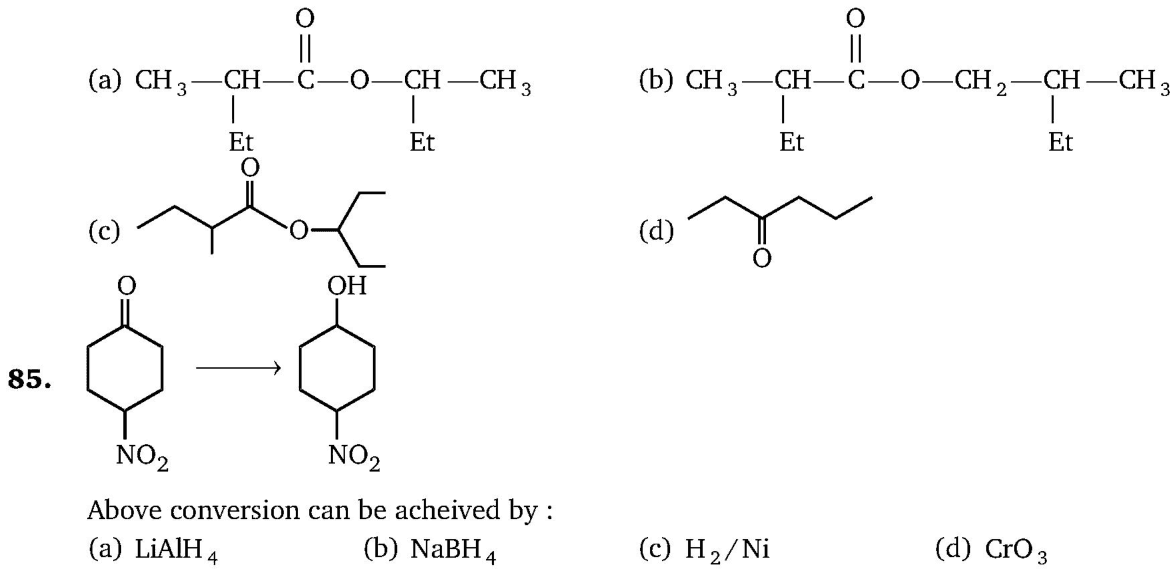
Concept: Selective reduction of a ketone in the presence of a nitro group. Step 1: Identify the functional groups present in the starting material. The substrate is 4-nitrocyclohexanone, which contains a ketone (C=O) and a nitro group (NO2). The target product is 4-nitrocyclohexanol, where only the ketone has been reduced to a secondary alcohol while the nitro group remains intact. Step 2: Evaluate each reagent. (a) LiAlH4: This is a powerful, non-selective reducing agent. It reduces ketones readily, but it also reduces nitro groups (converting -NO2 to -NH2). Using LiAlH4 would reduce both functional groups, giving an amino alcohol instead of the desired nitro alcohol. Therefore, LiAlH4 is not suitable. (b) NaBH4: Sodium borohydride is a mild, selective reducing agent. It selectively reduces ketones and aldehydes but does NOT reduce nitro groups under normal conditions. Thus, NaBH4 will reduce the ketone C=O to CHOH while leaving the -NO2 group untouched, giving 4-nitrocyclohexanol as the desired product. (c) H2/Ni: Catalytic hydrogenation with Ni reduces both the ketone and the nitro group (nitro groups are readily hydrogenated to amines over Ni). This would not give the desired product. (d) CrO3: This is an oxidizing agent (Jones reagent), not a reducing agent. It would oxidize an alcohol to a ketone, not reduce a ketone to an alcohol. Step 3: Conclusion. Only NaBH4 achieves selective reduction of the ketone without affecting the nitro group. Therefore, the correct answer is B.