See image — Aldehydes Ketones and Carboxylic Acids Chemistry Question
Question
See image
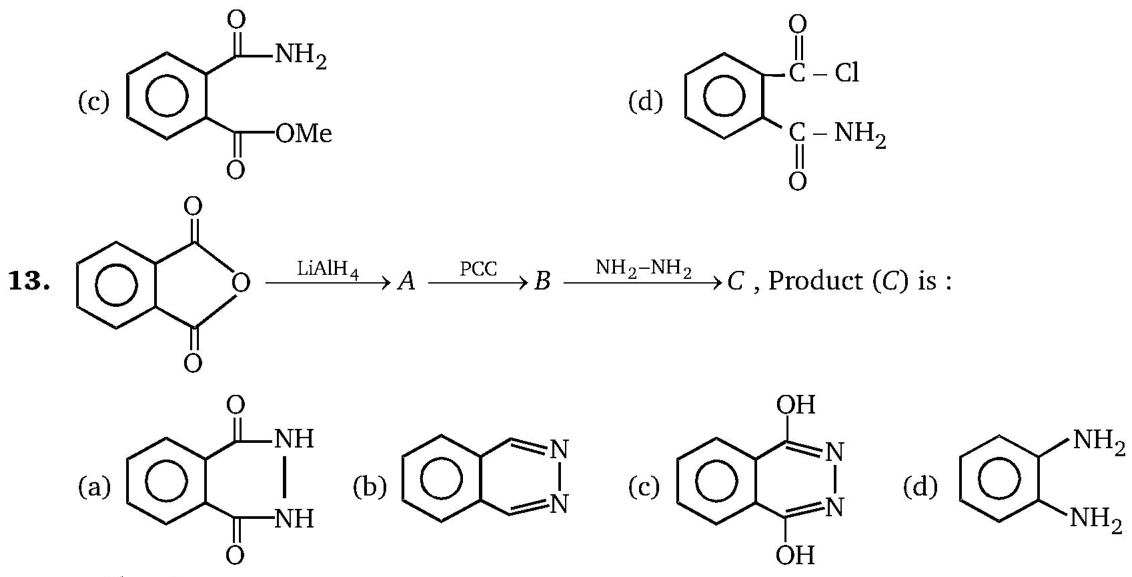
💡 Solution & Explanation
Step 1 - Identify the starting material: Phthalic anhydride (isobenzofuran-1,3-dione) is a benzene ring fused with a five-membered cyclic anhydride containing two carbonyl groups. Step 2 - Reaction with LiAlH4: LiAlH4 is a strong reducing agent that reduces anhydrides. It reduces the cyclic anhydride to give the diol. The two carbonyl groups of the anhydride are both reduced to CH2OH groups, yielding 1,2-bis(hydroxymethyl)benzene (o-xylene diol), compound A. Step 3 - Reaction with PCC: PCC (pyridinium chlorochromate) is a mild oxidizing agent that oxidizes primary alcohols to aldehydes without over-oxidizing to carboxylic acids. Both -CH2OH groups of A are oxidized to -CHO groups, giving phthalaldehyde (benzene-1,2-dicarbaldehyde), compound B. Step 4 - Reaction with NH2-NH2 (hydrazine): Hydrazine reacts with two aldehyde groups. The two aldehyde groups of phthalaldehyde react with the two NH2 groups of hydrazine (H2N-NH2) in a double condensation reaction. Each NH2 of hydrazine reacts with one CHO group, forming two imine (C=N) bonds with loss of two water molecules, and cyclization occurs to give a six-membered ring containing -CH=N-N=CH- fused to the benzene ring. This product is phthalazine (benzo[d]pyridazine), which has a benzene ring fused with a six-membered ring containing two adjacent nitrogen atoms connected by C=N bonds. Step 5 - Identify product C: The product is phthalazine, which matches option (b). Why other options fail: - Option (a): This would require reaction conditions forming amide bonds, not simple condensation of aldehydes with hydrazine. - Option (c): This would be the product if the reaction stopped at the hydrazone stage without full cyclization/aromatization, or if a different oxidation state were involved; also the OH groups suggest incomplete reaction. - Option (d): o-phenylenediamine would require complete reduction of the nitrogen-containing groups, not formation from aldehyde + hydrazine. Therefore, the correct answer is B.