See image — Alcohols Phenols and Ethers Chemistry Question
Question
See image
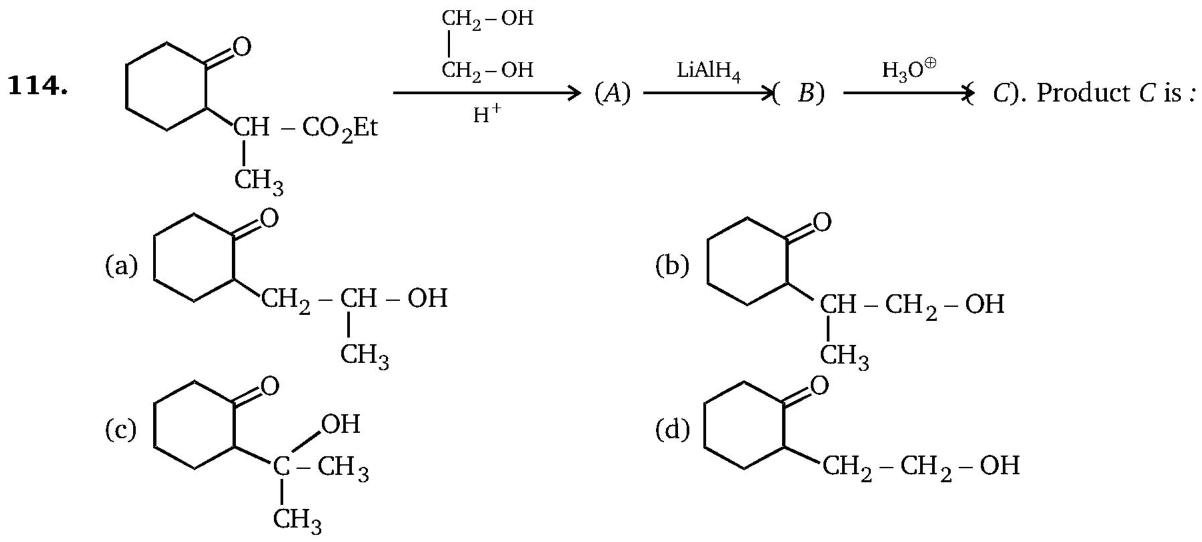
💡 Solution & Explanation
Step 1 - Identify the starting material: The starting material is 2-(1-(ethoxycarbonyl)ethyl)cyclohexan-1-one, which contains a ketone (cyclohexanone) and an ester group (-CO2Et) with a methyl substituent on the alpha carbon. Step 2 - Reaction with ethylene glycol under H+ to give (A): Ethylene glycol (HOCH2CH2OH) under acid catalysis selectively protects the ketone as a 1,3-dioxolane (cyclic acetal). Esters do not react with diols under these mild acidic conditions. So in (A), the cyclohexanone carbonyl is protected as a cyclic acetal, while the ester group (-CO2Et) remains intact. Step 3 - Reaction of (A) with LiAlH4 to give (B): LiAlH4 is a strong reducing agent that reduces esters to primary alcohols. The cyclic acetal is stable to LiAlH4. The ester -CO2Et is reduced to -CH2OH. So the side chain -CH(CH3)-CO2Et becomes -CH(CH3)-CH2OH, while the acetal protecting group on the ring remains intact. Step 4 - Reaction of (B) with H3O+ to give (C): Aqueous acid hydrolyzes the cyclic acetal back to the ketone. This regenerates the cyclohexanone carbonyl. The alcohol group -CH(CH3)-CH2OH remains unchanged under these conditions. Step 5 - Structure of product C: The product C is 2-(1-(hydroxymethyl)ethyl)cyclohexan-1-one, i.e., a cyclohexanone ring with a -CH(CH3)-CH2OH substituent at C2. This matches option (b): cyclohexanone ring with CH(CH3)-CH2-OH at C2. Why other options fail: - Option (a) has CH2-CH(OH)-CH3, which would require a different carbon connectivity than what reduction of the ester gives. - Option (c) has a tertiary alcohol C(OH)(CH3)2, which would require two methyl groups and no primary alcohol - inconsistent with ester reduction. - Option (d) has CH2-CH2-OH, which lacks the methyl group on the alpha carbon entirely. Therefore, the correct answer is B.