See image — Haloalkanes and Haloarenes Chemistry Question
Question
See image
💡 Solution & Explanation
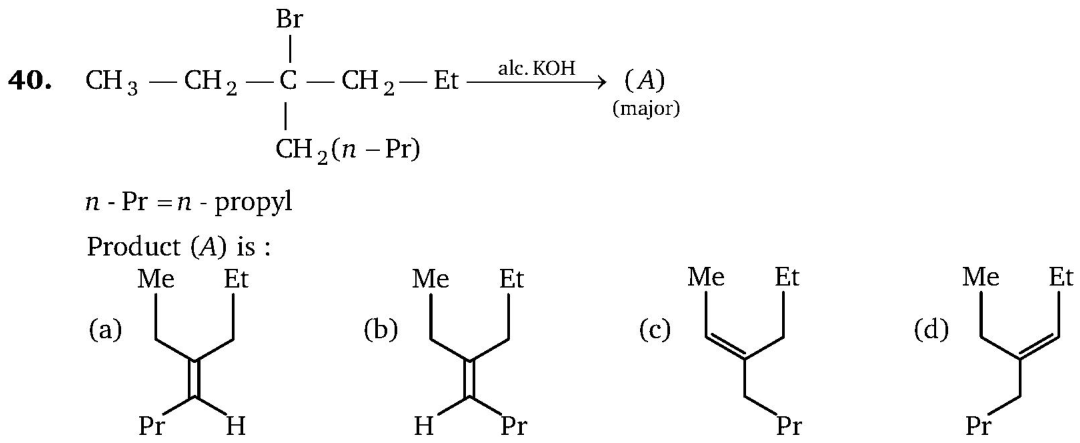
Step 1 - Identify the substrate: The starting material is a tertiary alkyl bromide. The central carbon bears: Br, CH2CH3 (ethyl), CH2-Et (another ethyl, since Et = CH2CH3), and CH2(n-Pr) (n-propylmethylene = CH2CH2CH2CH3). Wait, let me re-read: the structure is CH3-CH2-C(Br)(CH2-Et)(CH2(n-Pr)). So the central carbon has: one Br, one ethyl (CH2CH3) from the left chain (CH3-CH2-), one CH2-Et group, and one CH2(n-Pr) group. This is a tertiary bromide. Step 2 - Reaction conditions: Alcoholic KOH promotes E2 elimination (bimolecular elimination). The base abstracts a beta-hydrogen while Br leaves. Step 3 - Identify beta hydrogens: The beta carbons are the CH2 groups attached to the central carbon: (a) CH2 of the ethyl group from CH3-CH2- side, (b) CH2 of the CH2Et group, and (c) CH2 of the CH2(n-Pr) group. All three CH2 groups adjacent to the quaternary-like carbon bearing Br are beta carbons. Step 4 - Apply Zaitsev's rule: The major product of E2 elimination is the more substituted (more stable) alkene. Elimination toward the CH2Et group gives: the double bond forms between the central carbon and the CH2 of CH2Et, giving a trisubstituted alkene where the double bond carbon has Me (from CH3CH2- after losing one H from CH2) wait - actually the central carbon becomes the alkene carbon. Let me reconsider the structure. The central carbon C has: -CH2CH3 (call it branch A), -CH2Et = -CH2CH2CH3 (branch B, which is actually n-propyl when Et=C2H5, so CH2CH2CH3), -CH2(n-Pr) = -CH2CH2CH2CH3 (branch C, n-butyl chain), and Br. So branches: ethyl, n-propyl (from CH2Et where Et=C2H5), and n-butyl (from CH2-nPr where nPr=C3H7). Step 5 - E2 gives alkene. The double bond forms between the central C and one of the adjacent CH2 carbons. The more substituted alkene is preferred. Elimination toward CH2Et (giving =CH-CH3 on that side, with Et and n-Bu on the other carbon) gives a trisubstituted alkene. The central carbon of the alkene retains two substituents. Step 6 - The major product corresponds to elimination giving the most substituted double bond. With substituents Me, Et on one carbon and Pr on the other carbon of the double bond (as in option c, where the double bond carbon bears Me and Et, making it a 1,1-disubstituted type with the other carbon bearing CH2Pr), this is the most substituted alkene (trisubstituted overall considering all groups). Step 7 - Option (c) shows the double bond with Me and Et both on one carbon (=C(Me)(Et) end) and CH2Pr on the other carbon, representing elimination of H from the CH2 of the ethyl group giving a more substituted alkene with the double bond carbon bearing two alkyl groups (Me and the remaining part) — this corresponds to the Zaitsev product. Step 8 - Why not others: Options (a) and (b) show less substituted or differently connected alkenes. Option (d) has a different connectivity. Option (c) is the most substituted alkene product consistent with Zaitsev's rule for this tertiary bromide under E2 conditions. Therefore, the correct answer is C.