See image — Aldehydes Ketones and Carboxylic Acids Chemistry Question
Question
See image
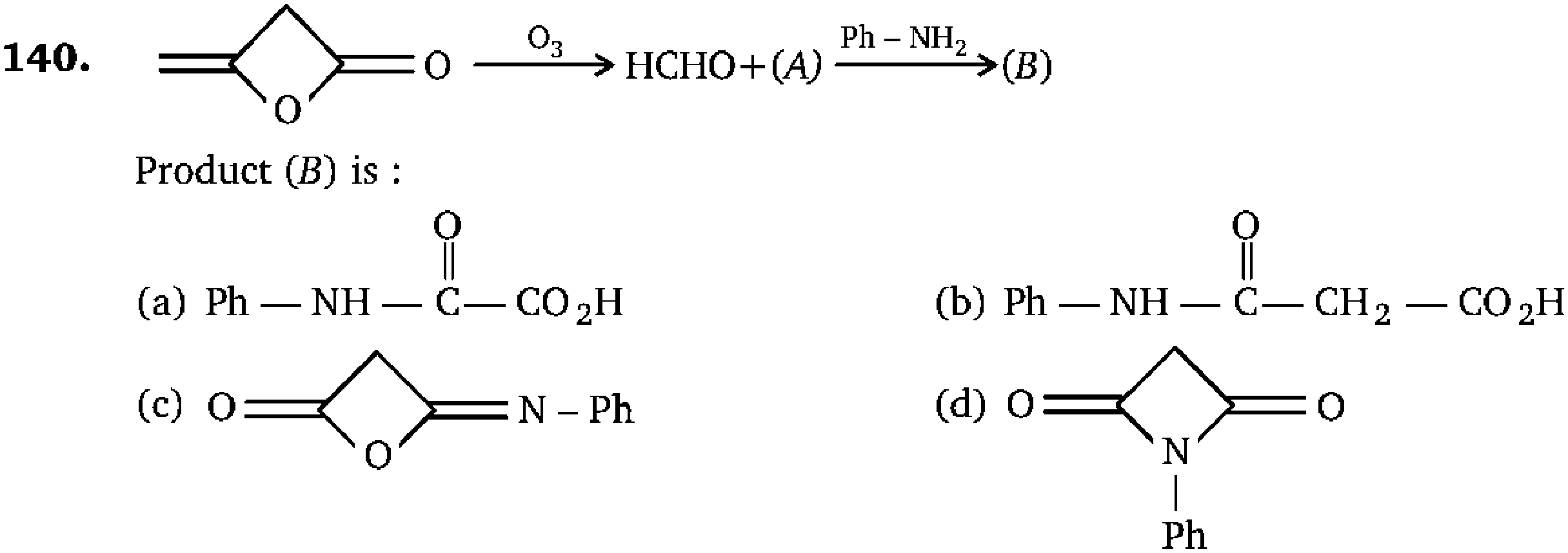
💡 Solution & Explanation
Step 1 – Identify the starting material. The starting material is 3-methylenebeta-propiolactone: a four-membered ring containing one oxygen, a carbonyl (C=O) at C2, and an exocyclic methylene (=CH2) at C3. Its structure is CH2=C(-O-C(=O)-) forming a four-membered ring, i.e., beta-propiolactone with an exocyclic double bond at C3. Step 2 – Ozonolysis of the exocyclic C=C. Ozonolysis of the exocyclic alkene (=CH2) cleaves the C=CH2 double bond. The terminal =CH2 gives formaldehyde (HCHO) as stated. The other fragment retains the ring-opened or intact portion. The carbonyl carbon of the exocyclic position in the ring becomes an aldehyde or keto-acid fragment upon ozonolysis with reductive workup. For beta-propiolactone with exocyclic methylene at C3, ozonolysis of C3=CH2 gives HCHO from the CH2 end and compound (A) from the ring carbon end. The ring carbon (C3) after cleavage becomes a carbonyl (C=O), giving OHC-O-C(=O)- which upon ring opening (the strained lactone opens) gives glyoxylic acid (OHC-COOH) or its equivalent: OHCCO2H (compound A = glyoxylic acid, OHC-CO2H). Step 3 – Reaction of (A) with aniline (Ph-NH2). Glyoxylic acid (OHC-CO2H) reacts with aniline (Ph-NH2). The aldehyde group of glyoxylic acid condenses with the amine to form an imine (Schiff base) initially, but under the reaction conditions the amine adds to the aldehyde and then acylation or amide bond formation can occur. More precisely, the amine reacts with the aldehyde carbonyl to give Ph-NH-CH(OH)-CO2H, which can oxidize or rearrange. However, considering the nucleophilic addition of Ph-NH2 to the aldehyde of OHC-CO2H followed by consideration of the product options, the amine attacks the carbonyl: the aldehyde of glyoxylic acid reacts with PhNH2 to form an amide-type product. Actually, glyoxylic acid has structure OHC-COOH; the amine can react with the aldehyde to give an amino alcohol or imine, but the correct product given is Ph-NH-C(=O)-CH2-CO2H (option b), which is N-phenylmalonamic acid (the monoamide of malonic acid with phenylamine on the acid side and a CH2-CO2H). This means (A) must actually be malonic acid half-aldehyde or that the ozonolysis gives OHC-CH2-CO2H (beta-formylpropionic acid). Re-examining: the starting material is 3-methylene-2-oxetanone (beta-lactone ring: O-CH2-C(=O) with the exo methylene on the CH2 carbon). Ozonolysis of CH2=C(ring) gives HCHO from exo-CH2 and (A) = O=CH-... The ring carbon bearing the exo double bond, after ozonolysis, gives an aldehyde that is still part of the ring: O=CH-O-C(=O)- which opens to give OHC-CH2-COOH (3-oxopropanoic acid = malonaldehyde mono acid, i.e., OHC-CH2-COOH). This (A) = malonaldehydic acid (OHC-CH2-CO2H) reacts with Ph-NH2: the amine adds to the aldehyde to give Ph-NH-CH(OH)-CH2-CO2H, which loses water to give imine, or more likely the aldehyde is oxidized/reacts to give the amide Ph-NH-C(=O)-CH2-CO2H via oxidative amidation. The product (B) = Ph-NH-C(=O)-CH2-CO2H matches option (b). Step 4 – Why other options fail. (a) Ph-NH-C(=O)-CO2H would require (A) to be glyoxylic acid without a CH2, inconsistent with the four-membered ring ozonolysis. (c) and (d) involve ring-containing products that are not consistent with ozonolytic cleavage followed by amine reaction under these conditions. Therefore, the correct answer is B.