See image — IUPAC and Nomenclature Chemistry Question
Question
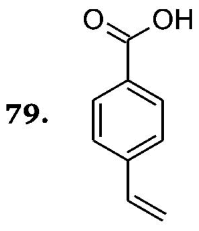
See image
💡 Solution & Explanation
Step 1 (Identify the parent chain/ring): The compound contains a benzene ring as the principal cyclic structure, which forms the base of the IUPAC name 'benzoic acid' when a carboxylic acid group is directly attached to it. Step 2 (Identify substituents): There are two groups on the benzene ring: (a) a -COOH (carboxylic acid) group and (b) a -CH=CH2 (vinyl/ethenyl) group. These two groups are located at opposite ends of the ring (para relationship, i.e., 1,4-positions). Step 3 (Assign principal characteristic group): The carboxylic acid (-COOH) is the principal characteristic group and defines the parent name. When -COOH is directly attached to benzene, the parent name is 'benzoic acid,' and C1 is the carbon bearing -COOH. Step 4 (Name the substituent): The -CH=CH2 group is a vinyl group. In IUPAC nomenclature it is called 'ethenyl' (ethen- for the two-carbon alkene, -yl for the substituent form). Step 5 (Assign locant): Since -COOH is at C1 by definition in benzoic acid, the ethenyl group at the para position receives the locant 4, giving '4-ethenyl.' Step 6 (Combine): Parent = benzoic acid; substituent = 4-ethenyl; full name = 4-ethenylbenzoic acid. No alternative options are provided in this question, so no elimination step is needed. Therefore, the correct answer is 4-ethenylbenzoic acid.