See image — Aldehydes Ketones and Carboxylic Acids Chemistry Question
Question
See image
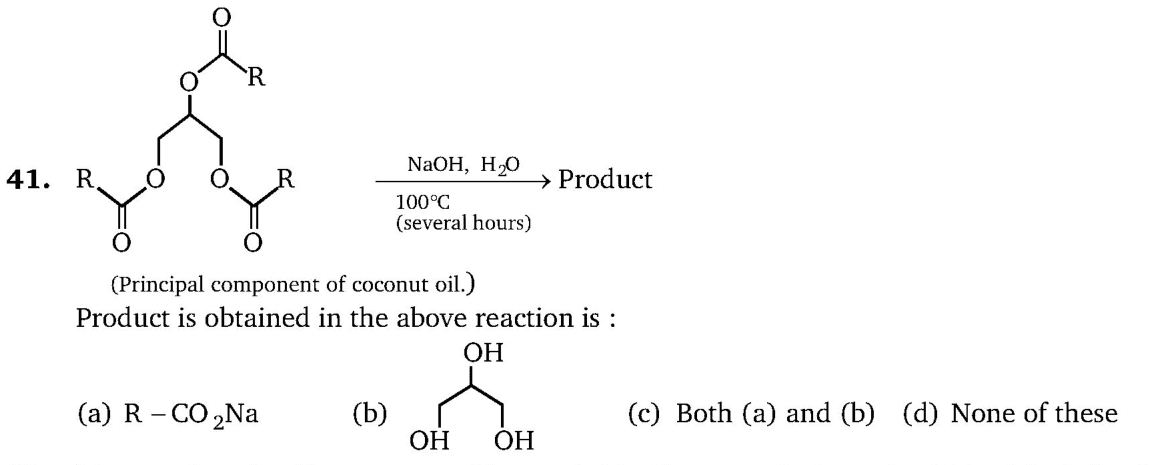
💡 Solution & Explanation
Concept: Saponification is the base-catalyzed hydrolysis of an ester. When a triglyceride (glycerol triester) is treated with aqueous NaOH (a strong base) at elevated temperature (100°C) for several hours, all three ester bonds undergo hydrolysis. Step 1: Identify the reactant. The structure shown is a triglyceride — glycerol esterified at all three hydroxyl positions with fatty acid chains (R-CO-O-). This is described as the principal component of coconut oil, which is trilaurin (glyceryl trilaurate), where R = C11H23 (undecyl chain giving lauric acid). Step 2: Reaction mechanism. Each ester bond (R-COO-CH2- or R-COO-CH-) undergoes nucleophilic acyl substitution with OH- from NaOH. The hydroxide ion attacks the carbonyl carbon of each ester, breaking the C-O bond and releasing the alkoxide (which is part of glycerol), and forming the carboxylate salt. Step 3: Products formed. - Each of the three ester groups is hydrolyzed: R-COO- + Na+ → R-CO2Na (sodium carboxylate / soap). Three moles of R-CO2Na are produced per mole of triglyceride. - After all three ester bonds are cleaved from glycerol, the glycerol backbone is released as free glycerol: HOCH2-CH(OH)-CH2OH (propane-1,2,3-triol), which is the structure shown in option (b). Step 4: Evaluate options. - Option (a) R-CO2Na: This is the sodium salt of the fatty acid (soap). Correct, it IS produced. - Option (b) Glycerol (HOCH2-CH(OH)-CH2OH): Also correct, it IS produced as the other product. - Option (c) Both (a) and (b): Both products are formed simultaneously in the saponification reaction, so this is the complete and correct answer. - Option (d) None of these: Incorrect, as both (a) and (b) are genuine products. Step 5: Conclusion. Saponification of a triglyceride with NaOH/H2O yields soap (fatty acid sodium salt, R-CO2Na) AND glycerol. Both option (a) and option (b) are correct products. Therefore, the correct answer is C.