See image — Hydrocarbons Chemistry Question
Question
See image
💡 Solution & Explanation
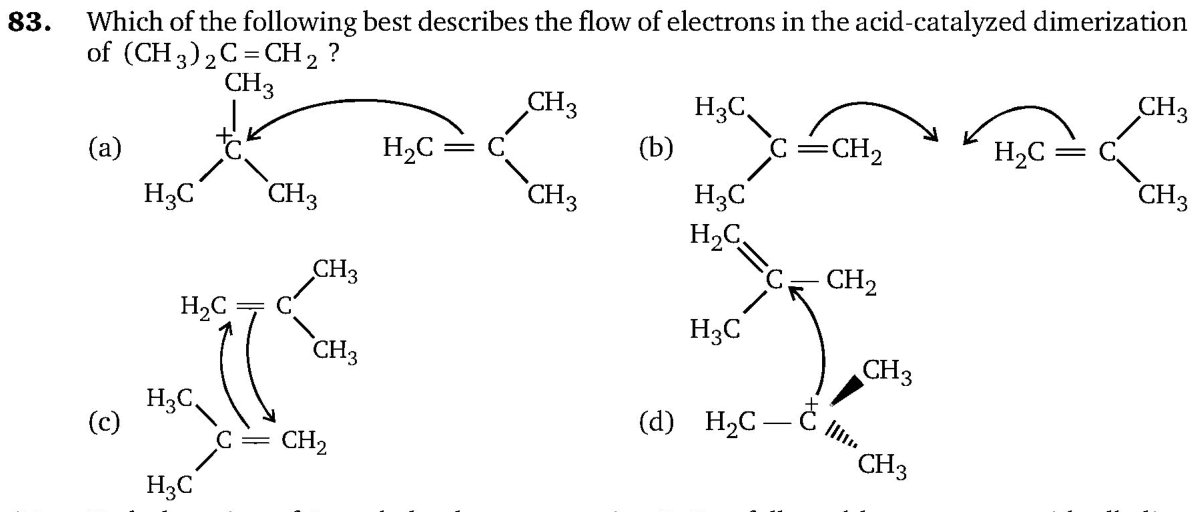
Step 1 - Concept: Acid-catalyzed dimerization of isobutylene (2-methylpropene, (CH3)2C=CH2) proceeds via a carbocation mechanism. The acid (H+) protonates the alkene to generate the more stable tertiary carbocation (CH3)3C+ (tert-butyl cation) following Markovnikov's rule. Step 2 - Mechanism: Once the tert-butyl carbocation (CH3)3C+ is formed, a second molecule of (CH3)2C=CH2 acts as a nucleophile. The pi electrons of the second alkene molecule attack the electrophilic carbocation carbon. This is represented by a curved arrow from the pi bond of the second isobutylene molecule pointing toward the positive carbon of the carbocation. Step 3 - Electron flow description: In option (a), the curved arrow originates from the pi bond of H2C=C(CH3)2 and points toward the (CH3)3C+ carbocation. This correctly shows the nucleophilic pi electrons of the alkene attacking the electrophilic carbocation, which is exactly the key C-C bond-forming step in the cationic dimerization. Step 4 - Why other options fail: - Option (b) shows arrows pointing toward each other between two neutral alkene molecules, implying a concerted [2+2] or similar pericyclic process, which is not the acid-catalyzed ionic mechanism. - Option (c) shows electron flow from one alkene into another in a direction inconsistent with attack on a carbocation; it does not depict a carbocation intermediate at all. - Option (d) shows an intramolecular arrow within a single carbocation species suggesting ring closure or hydride shift, which does not represent the intermolecular C-C bond formation step of dimerization. Therefore, the correct answer is A.