See image — Haloalkanes and Haloarenes Chemistry Question
Question
See image
💡 Solution & Explanation
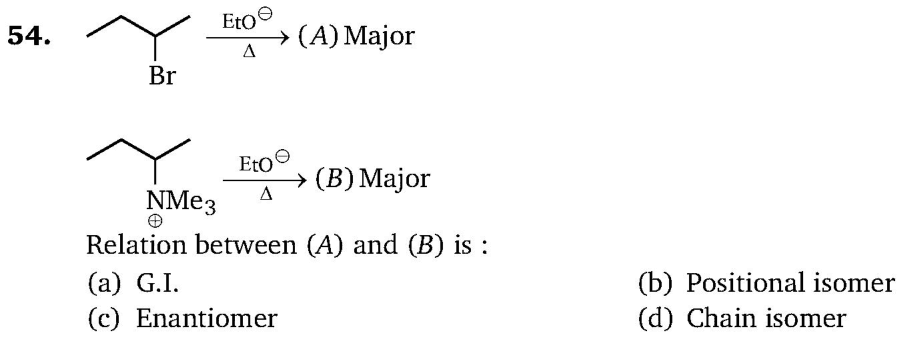
Step 1 - Identify the substrates and reactions: Reaction 1: 2-bromobutane (CH3CHBrCH2CH3) treated with EtO(-) (a strong base) under heat undergoes E2 elimination. The substrate is a secondary alkyl halide. Reaction 2: 2-butyltrimethylammonium salt (CH3CH(NMe3+)CH2CH3) treated with EtO(-) under heat undergoes Hofmann elimination (E2 on a quaternary ammonium salt). Step 2 - Determine major product (A) from 2-bromobutane via E2: In E2 elimination of 2-bromobutane, the base can abstract a proton from C1 (giving 1-butene) or from C3 (giving 2-butene). According to Zaitsev's rule, the more substituted alkene is the major product. Therefore, (A) = 2-butene (but-2-ene), the more substituted alkene. Step 3 - Determine major product (B) from 2-butyltrimethylammonium salt via Hofmann elimination: Hofmann elimination (with a bulky or poor leaving group like NMe3) favors formation of the less substituted alkene (less hindered beta-hydrogen is abstracted). Therefore, (B) = 1-butene (but-1-ene), the less substituted alkene. Step 4 - Determine the relationship between (A) and (B): (A) is 2-butene: CH3-CH=CH-CH3 (C4H8, double bond at C2) (B) is 1-butene: CH2=CH-CH2-CH3 (C4H8, double bond at C1) Both (A) and (B) have the same molecular formula (C4H8) and the same carbon chain length (4 carbons, straight chain), but differ in the position of the double bond. This makes them positional isomers (same molecular formula, same carbon skeleton, different position of the functional group). Step 5 - Eliminate other options: (a) G.I. (Geometrical Isomers) - 2-butene has geometric isomers (cis/trans), but 1-butene and 2-butene are not geometric isomers of each other. (c) Enantiomers - both are achiral alkenes, not mirror images. (d) Chain isomers - chain isomers differ in the carbon skeleton arrangement; both A and B have the same straight-chain 4-carbon skeleton, so they are not chain isomers. Therefore, the correct answer is B.