See image — Hydrocarbons Chemistry Question
Question
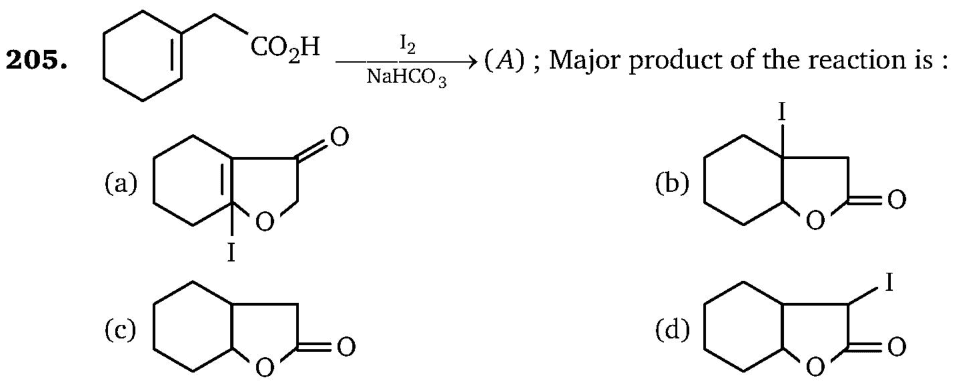
See image
💡 Solution & Explanation
Concept: Iodolactonization is an electrophilic cyclization reaction where I2 acts as the electrophile toward a carbon-carbon double bond, and an internal carboxylate (formed under basic conditions with NaHCO3) acts as the nucleophile to form a lactone ring via intramolecular attack. Step 1: Under NaHCO3 conditions, the carboxylic acid is deprotonated to form the carboxylate anion. The substrate is (cyclohex-1-en-1-yl)acetic acid, which has the double bond endocyclic in the cyclohexene ring and the -CH2CO2H group on the sp2 carbon of the double bond. Step 2: I2 activates the double bond by forming an iodonium ion intermediate. The iodonium bridges across the double bond carbons of the cyclohexene ring. Step 3: The carboxylate oxygen attacks one of the carbons of the iodonium ion in an anti fashion (backside attack, SN2-like). The carboxylate carbon is -CH2- which is one carbon removed from the double bond carbon bearing the CH2CO2- group. The oxygen attacks the more substituted carbon (the one bearing the CH2CO2- group, which is also the ring junction carbon) following Baldwin's rules for 5-exo-tet cyclization favored, but here geometry dictates attack at the tertiary/more substituted carbon of the iodonium. Step 4: The nucleophilic carboxylate oxygen attacks the carbon of the cyclohexene ring that is directly attached to the CH2 group (i.e., C1 of cyclohexene), forming a 5-membered lactone ring (beta-lactone would be 4, gamma-lactone is 5-membered: O-CH2-C=O with the ring closed through the C1 of cyclohexene). This creates a spiro center at C1 of the original cyclohexene ring, now bearing the iodine (from anti addition) and the oxygen of the lactone. Step 5: The product is a spiro compound where the iodine and the lactone oxygen are on the same quaternary carbon (the former C1 of cyclohexene), with anti stereochemistry. The cyclohexane ring and the gamma-butyrolactone ring share this spiro carbon, and iodine is on that spiro carbon. This matches option (b): a spiro lactone with I at the spiro (quaternary) carbon, 5-membered lactone ring, and intact cyclohexane ring. Why other options fail: - Option (a): Shows a double bond remaining in the cyclohexene ring and iodo at the spiro carbon with an unsaturated bicycle - iodolactonization consumes the double bond, so no remaining alkene is expected as the major product. - Option (c): No iodine in the product - iodolactonization always incorporates iodine; this would require loss of I which doesn't occur under these conditions. - Option (d): Shows iodo on the carbon alpha to the carbonyl (exo to the spiro center) in a fused ring system - this would require 6-endo-tet cyclization and different regiochemistry; the 5-exo-tet pathway (Baldwin's rules favored) giving the spiro product is preferred, and anti addition places I on the spiro carbon not on the exo carbon. Therefore, the correct answer is B.