See image — Aldehydes Ketones and Carboxylic Acids Chemistry Question
Question
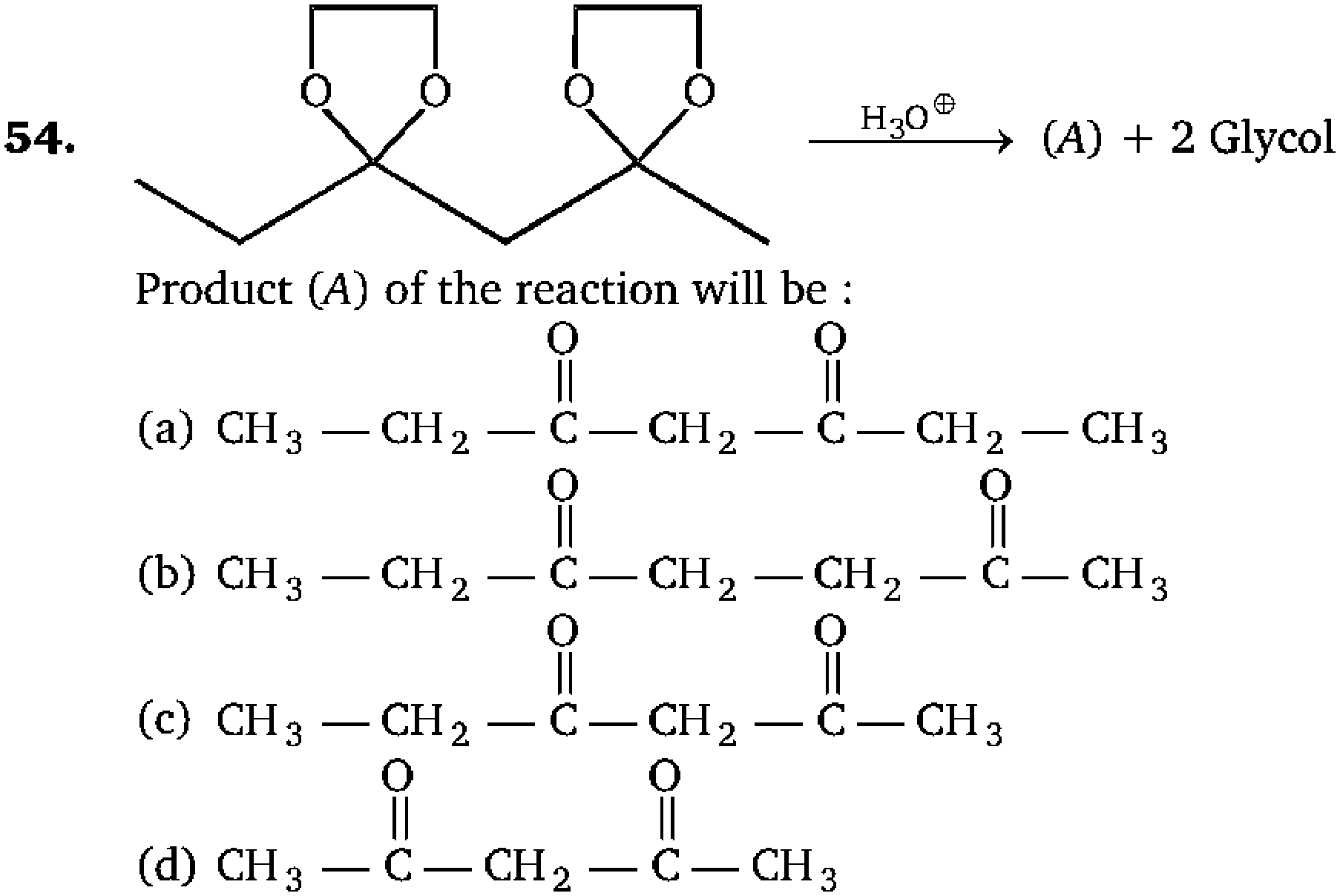
See image
💡 Solution & Explanation
Step 1 - Concept: Acetals are hydrolyzed under aqueous acid (H3O+) conditions to regenerate the parent carbonyl compound and the diol (glycol). Each 1,3-dioxolane acetal upon hydrolysis releases one equivalent of ethylene glycol (HOCH2CH2OH) and regenerates the ketone carbonyl at that carbon. Step 2 - Identify the two acetal centers: - Left acetal carbon: part of a 1,3-dioxolane ring, bears an ethyl group (CH2CH3) and a -CH2- group connecting to the right acetal carbon. Upon hydrolysis, this becomes a ketone: the carbon bonded to ethyl and -CH2- becomes C=O, giving an ethyl ketone fragment: CH3CH2-C(=O)-CH2-. - Right acetal carbon: part of a 1,3-dioxolane ring, bears a methyl group (CH3) and the -CH2- bridge. Upon hydrolysis, this becomes a ketone: the carbon bonded to methyl and -CH2- becomes C=O, giving a methyl ketone fragment: -CH2-C(=O)-CH3. Step 3 - Assemble product A: Combining both fragments through the -CH2- bridge: CH3-CH2-C(=O)-CH2-C(=O)-CH3 This is a 1,3-diketone: hexane-2,4-dione with an ethyl on one end... specifically: ethyl group on left carbonyl carbon and methyl on right carbonyl carbon, connected by one -CH2-. The structure is: CH3CH2-C(=O)-CH2-C(=O)-CH3 (3-methylpentane-2,4-dione or pentan-2,4-dione with ethyl... actually this is hexane-3,5-dione: CH3CH2-CO-CH2-CO-CH3). Step 4 - Match to options: (a) CH3-CH2-C(=O)-CH2-C(=O)-CH2-CH3: both sides have ethyl groups - incorrect, right side should be methyl. (b) CH3-CH2-C(=O)-CH2-CH2-C(=O)-CH3: has two CH2 groups between carbonyls - incorrect, bridge is only one CH2. (c) CH3-CH2-C(=O)-CH2-C(=O)-CH3: left carbonyl has ethyl, right carbonyl has methyl, one CH2 bridge - this matches perfectly. (d) CH3-C(=O)-CH2-C(=O)-CH3: both sides methyl, no ethyl - incorrect. Step 5 - Why others fail: Option (a) has two ethyl groups; the right acetal bore only a methyl. Option (b) has a -CH2CH2- bridge; the structure shows a single -CH2- between the two acetal carbons. Option (d) has methyl groups on both sides, ignoring the ethyl substituent. Therefore, the correct answer is C.