See image — IUPAC and Nomenclature Chemistry Question
Question
See image
💡 Solution & Explanation
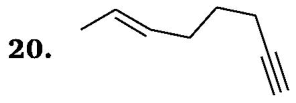
Step 1 – Identify the functional groups. The structure shows a terminal triple bond (alkyne) on the right end and an internal double bond with a trans configuration on the left end. Step 2 – Count the carbon chain. Starting from the terminal alkyne carbon: C1≡C2-C3-C4-C5-C6=C7-C8. That gives 8 carbons total, so the parent chain is octane → oct. Step 3 – Assign the principal characteristic group and numbering. An alkyne and alkene are both present. According to IUPAC rules, the chain is numbered to give the principal group (alkyne) the lower locant. Numbering from the alkyne end: the triple bond is at C1 (terminal, so 'oct-1-yne' would be written as 'oct-1-yne', but since it is terminal the name uses 'oct-1-yne'). The double bond falls between C6 and C7, giving 'oct-6-en-1-yne' (yne suffix gets lower locant). Step 4 – Assign geometry. The double bond at C6–C7 has: on C6, a four-carbon chain (higher priority) vs H; on C7, a methyl group (higher priority) vs H. The two higher-priority groups are on opposite sides → E configuration. Step 5 – Compile the name. Parent chain: oct. Alkyne at C1: 1-yne. Alkene at C6: 6-en. Geometry: (6E). Full name: (6E)-oct-6-en-1-yne. No other options are present to eliminate, but alternative numbering from the alkene end would give the triple bond at C8 (higher locant), which is incorrect by IUPAC rules. Therefore, the correct answer is (6E)-oct-6-en-1-yne.