See image — Reaction Mechanism Chemistry Question
Question
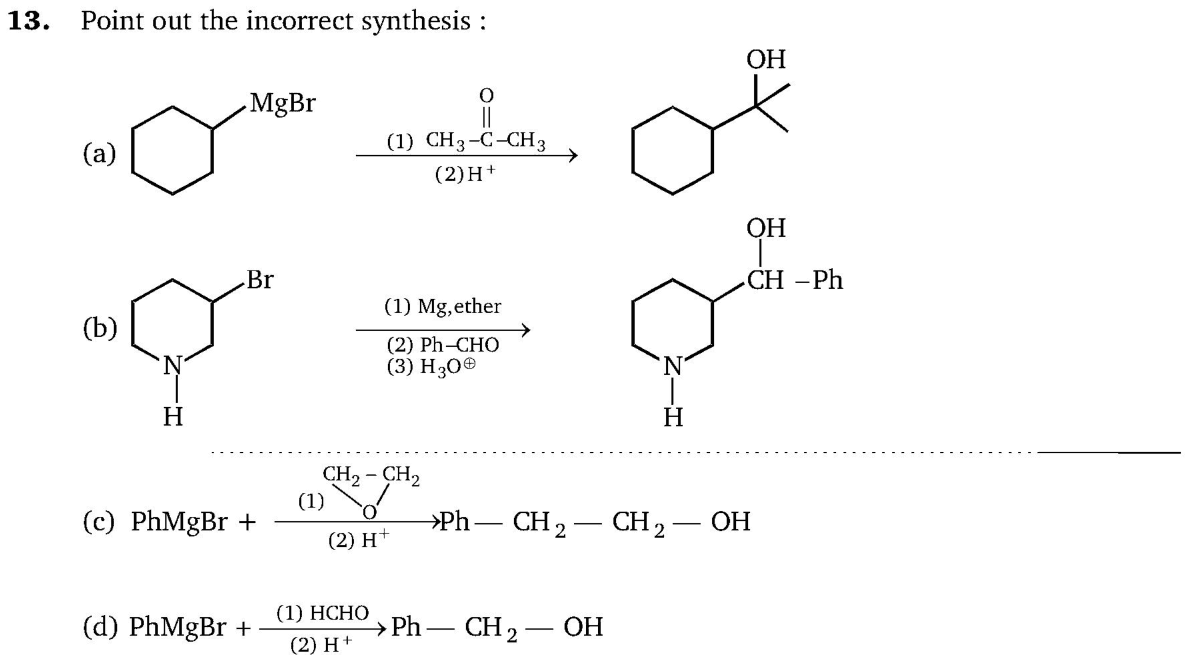
See image
💡 Solution & Explanation
Concept: Grignard reagents require formation of an organomagnesium species from an alkyl/aryl halide and Mg metal in anhydrous ether. A critical requirement is that no acidic protons (active hydrogens) be present in the molecule, because they would protonate and destroy the Grignard reagent before it can react with the electrophile. Step 1 - Analyze option (b): The starting material is 3-bromopiperidine, which contains a secondary amine (N-H). The N-H proton is an active hydrogen (pKa ~35 for amines, but the Grignard reagent acts as a strong base and would be protonated by the N-H). When Mg is added in ether, the Grignard reagent cannot form properly because the N-H bond in the same molecule would immediately protonate the C-MgBr bond, destroying the reagent. Therefore, the synthesis shown in (b) is not feasible as written. Step 2 - Verify option (a): Cyclohexyl MgBr reacts with acetone (a ketone) to give a tertiary alcohol after protonation. Cyclohexyl group adds to carbonyl carbon of acetone → 1-cyclohexyl-1-methylethanol. This is correct. Step 3 - Verify option (c): PhMgBr reacts with ethylene oxide (a cyclic epoxide) via ring-opening at the less hindered carbon, extending the chain by two carbons, giving Ph-CH2-CH2-OH after protonation. This is correct. Step 4 - Verify option (d): PhMgBr reacts with formaldehyde (HCHO) to give, after protonation, Ph-CH2-OH (benzyl alcohol). This is correct. Step 5 - Conclusion: Option (b) is incorrect because the secondary amine (N-H) in the piperidine ring acts as an active hydrogen source that would destroy the Grignard reagent upon its attempted formation. The Grignard reaction cannot proceed as described. Therefore, the correct answer is B.