See image — Alcohols Phenols and Ethers Chemistry Question
Question
See image
💡 Solution & Explanation
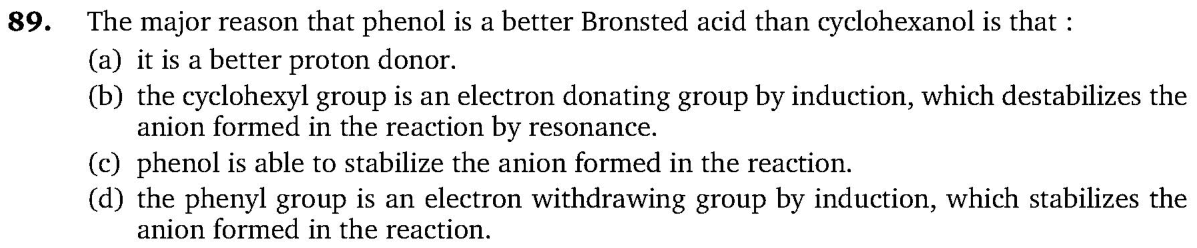
Concept: The strength of a Bronsted acid depends on the stability of its conjugate base (the anion formed after proton donation). The more stable the conjugate base, the stronger the acid. Step 1: When phenol (C6H5OH) loses a proton, it forms the phenoxide ion (C6H5O-). When cyclohexanol loses a proton, it forms the cyclohexoxide ion (C6H11O-). Step 2: The phenyl group (C6H5-) is sp2 hybridized and acts as an electron-withdrawing group by induction (through the sigma framework) compared to the sp3 cyclohexyl group. This electron withdrawal disperses the negative charge on the oxygen in phenoxide, stabilizing the anion. Step 3: Additionally, the phenoxide ion is stabilized by resonance delocalization of the negative charge into the aromatic ring (across the ortho and para positions). The cyclohexoxide ion has no such resonance stabilization. Step 4: Evaluating each option: - (a) 'It is a better proton donor' is circular reasoning and not an explanation of WHY it is better - this fails. - (b) States cyclohexyl destabilizes the anion by resonance - cyclohexyl has no resonance, and this conflates induction and resonance incorrectly - this fails. - (c) 'Phenol is able to stabilize the anion formed in the reaction' is correct in conclusion but vague and incomplete as a mechanistic explanation - it does not specify the reason. - (d) States the phenyl group is an electron-withdrawing group by induction, which stabilizes the anion - this correctly identifies the inductive electron withdrawal by the phenyl group as a key stabilizing factor for the phenoxide anion. Step 5: Option (d) provides the most precise mechanistic reason: the phenyl group withdraws electron density inductively, stabilizing the negatively charged phenoxide ion relative to cyclohexoxide. Therefore, the correct answer is D.