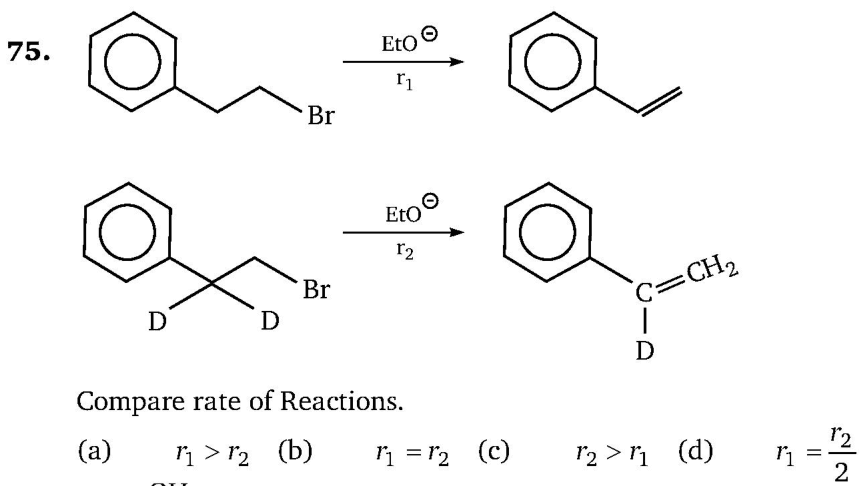
See image — Haloalkanes and Haloarenes Chemistry Question
Question
See image
💡 Solution & Explanation
Concept: E2 elimination mechanism and the kinetic isotope effect (KIE). Step 1: Identify the mechanism. Both reactions proceed via E2 (bimolecular elimination) with EtO- as the base. In E2, the rate-determining step involves simultaneous removal of a beta-hydrogen (or deuterium) by the base, breaking of the C-H(D) bond, and departure of the leaving group (Br-). Step 2: Reaction 1 analysis. In (3-bromopropyl)benzene, Ph-CH2-CH2-CH2Br, the beta carbon to the Br bears regular hydrogen atoms (C-H bonds). EtO- abstracts a beta-H in the rate-determining step. No isotope effect applies. Step 3: Reaction 2 analysis. In Ph-CD2-CH2Br, the beta carbon (the CD2 group) bears deuterium atoms instead of hydrogen. EtO- must abstract a beta-D in the rate-determining step to form Ph-CD=CH2. Because the C-D bond has a lower zero-point energy than C-H (deuterium is heavier), the activation energy for C-D bond breaking is higher than for C-H bond breaking. Step 4: Primary kinetic isotope effect. The primary KIE (kH/kD) typically ranges from 2 to 7 at room temperature. Since reaction 1 involves C-H bond breaking and reaction 2 involves C-D bond breaking at the beta position, r1 > r2 due to the primary kinetic isotope effect. Step 5: Why other options fail. (b) r1 = r2 is wrong because KIE makes C-H abstraction faster than C-D abstraction. (c) r2 > r1 is wrong because C-D bonds are stronger/harder to break. (d) r1 = r2/2 is wrong; the ratio goes in the opposite direction and the numerical factor is not supported. Therefore, the correct answer is A.