See image — Aldehydes Ketones and Carboxylic Acids Chemistry Question
Question
See image
💡 Solution & Explanation
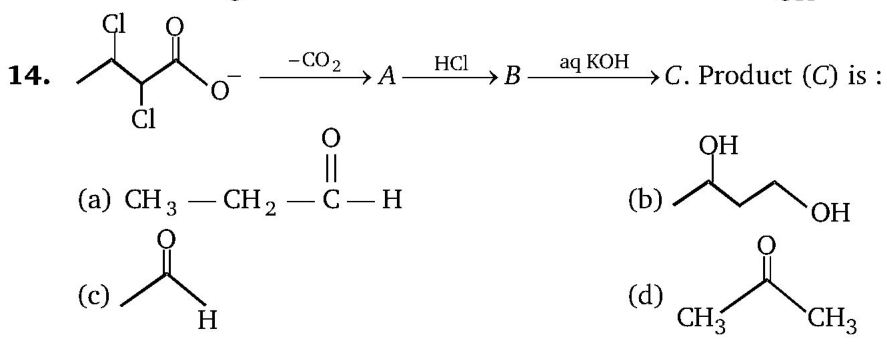
Step 1: Identify the starting material. The starting material is the carboxylate anion of 2,3-dichlorobutanoic acid... wait, let me re-read the structure. The structure shows a carboxylate (COO-) with a CHCl group alpha to it and a CHCl-CH3 arrangement. So the starting material is the anion of 2,3-dichlorobutanoic acid: CH3-CHCl-CHCl-COO-. Step 2: Decarboxylation (-CO2). Loss of CO2 from the carboxylate anion gives a carbanion or alkene via elimination. In decarboxylation of a beta-halo acid salt, loss of CO2 gives an alkene. With 2,3-dichlorobutanoate losing CO2, the alpha carbon (C2, bearing Cl) loses CO2 to give CH3-CHCl-CH2- carbanion, but more likely it proceeds via an E2-type decarboxylation. Actually, for alpha,beta-dihalo carboxylates, decarboxylation gives the vinyl chloride or alkene. Let me reconsider: Starting material is CH3-CHCl-CHCl-COO-. Decarboxylation (loss of CO2): The carboxylate loses CO2, and since there is a beta-chloro group, this is a beta-elimination type decarboxylation giving CH3-CHCl-CH=CH2? No. Actually for alpha-halo carboxylate anions, decarboxylation gives alpha-halo carbanion which loses Cl- to give alkene. So CH3-CHCl-CHCl-COO- loses CO2 to give CH3-CHCl-CHCl(-) carbanion, which then loses Cl- to give CH3-CHCl-CH=CH2... Wait, let me reconsider the structure. Looking again: the structure shows COO- attached to CH(Cl) attached to CH(Cl) attached to CH3. So it is: CH3-CHCl-CHCl-COO-. Decarboxylation of alpha-chloro carboxylate: loss of CO2 from CHCl-COO- gives CHCl carbanion -> loss of Cl- gives alkene. So A = CH3-CHCl-CH=CH2 (but-1-ene-2-yl chloride? No, 1-chloro-1-propene from elimination of adjacent Cl). Actually: CH3-CHCl-CHCl-COO- loses CO2 to give [CH3-CHCl-CHCl]- which eliminates Cl- to give CH3-CHCl-CH=CH2 or CH3-CH=CH-CH3 (but-2-ene)... Simpler interpretation: The carboxylate is from 2,3-dichloro acid. Loss of CO2 from the carboxylate (beta-keto acid analogy) - here with alpha,beta-dichloro: A = CH3-CHCl-CH2Cl (1,2-dichloropropane) by protonation, or an alkene. Step 3: A + HCl -> B. If A is an alkene (propene or similar), adding HCl gives an alkyl chloride. Step 4: B + aq KOH -> C. Aqueous KOH hydrolyzes alkyl halide to alcohol, or causes elimination. Given the answer is (a) propanal (CH3CH2CHO): Working backwards: C = propanal. KOH(aq) on B gives propanal - this suggests B is 1,1-dichloropropane (gem-dichloride), since gem-dihalides with aq KOH give aldehydes. So B = CH3CH2CHCl2. B comes from A + HCl. A = CH3CH=CHCl (1-chloropropene) + HCl -> CH3CH2CHCl2 (Markovnikov addition). A = CH3CH=CHCl (1-chloro-1-propene or allyl chloride variant). A comes from decarboxylation of CH3CHCl-CHCl-COO-: loss of CO2 and Cl- gives CH3CH=CHCl (1-chloroprop-1-ene). This is consistent: the decarboxylation of the alpha,beta-dichloro carboxylate gives alpha,beta-elimination producing CH3-CH=CHCl (A). Then A + HCl -> CH3CH2CHCl2 (B, by addition of HCl with Cl going to C1). Then B + aq KOH: gem-dichloride hydrolysis: CH3CH2CHCl2 + 2KOH -> CH3CH2CHO + 2KCl + H2O. This gives propanal = product C = option (a). Therefore, the correct answer is A.