See image — IUPAC and Nomenclature Chemistry Question
Question
See image
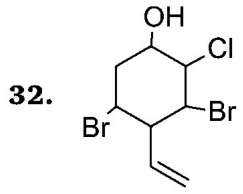
💡 Solution & Explanation
Step 1: Identify the parent chain. The compound is a cyclohexane ring, so the parent name is cyclohexanol (since OH is the principal characteristic group). Step 2: Number the ring to give the principal characteristic group (OH) the lowest possible locant. Assign C1 to the carbon bearing OH. Step 3: Identify all substituents and their positions by going around the ring: - C1: OH (principal group, defines numbering) - C2: Cl (adjacent to OH) - C3: Br - C4: ethenyl (vinyl, CH=CH2) - C5: Br Step 4: Choose the direction of numbering that gives the substituents the lowest set of locants. Numbering so that Cl is at C2, Br at C3, ethenyl at C4, and Br at C5 gives locants {1,2,3,4,5}, which is consistent with the structure shown. Step 5: Assemble the IUPAC name. List substituents alphabetically as prefixes: bromo (×2 = dibromo), chloro, ethenyl. The name becomes: 3,5-dibromo-2-chloro-4-ethenylcyclohexan-1-ol, commonly written as 3,5-dibromo-2-chloro-4-ethenylcyclohexanol. Step 6: Verify the name matches the structure — OH at C1, Cl at C2, Br at C3, ethenyl at C4, Br at C5 on a cyclohexane ring. This matches the drawn structure. Therefore, the correct answer is 3,5-dibromo-2-chloro-4-ethenylcyclohexanol.