See image — Haloalkanes and Haloarenes Chemistry Question
Question
See image
💡 Solution & Explanation
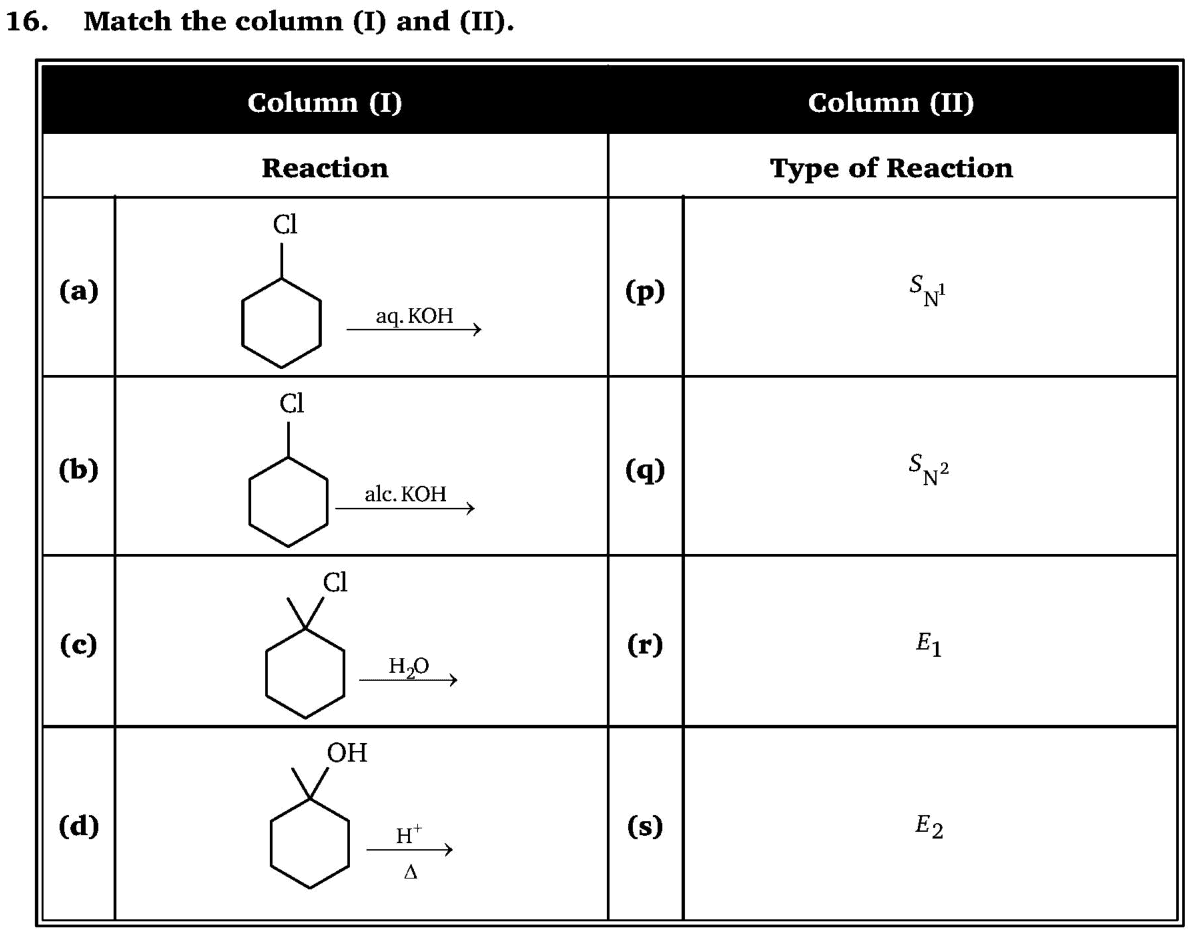
Step 1 - Analyze each reaction substrate and reagent: (a) Chlorocyclohexane (secondary alkyl chloride) + aq. KOH: Aqueous KOH provides OH⁻ as a nucleophile in a polar protic solvent. Secondary alkyl halides with a strong nucleophile/weak base in aqueous conditions favor S_N2 because the nucleophile is good and the secondary carbon is accessible enough. This matches (q) S_N2. (b) 1-Chloro-1-methylcyclohexane (tertiary alkyl chloride) + alc. KOH: Alcoholic KOH provides OH⁻ in a less polar (protic but less ionizing) solvent. Tertiary alkyl halides cannot undergo S_N2 due to steric hindrance. Alcoholic KOH is a strong base that favors elimination. With a tertiary substrate and a strong base in alcoholic conditions, E2 elimination is favored. This matches (s) E2. (c) 1-Chloro-1-methylcyclohexane (tertiary alkyl chloride) + H2O: Water is a weak nucleophile and poor base. Tertiary alkyl halides with a weak nucleophile/neutral solvent (polar protic, ionizing) undergo S_N1 via carbocation intermediate. The tertiary carbocation is stable. This matches (p) S_N1. (d) 1-Methyl-1-cyclohexanol (tertiary alcohol) + H⁺, heat (Delta): Acid-catalyzed dehydration of a tertiary alcohol proceeds via protonation of OH, loss of water to form a stable tertiary carbocation, then loss of a proton (E1 mechanism). Heat and acid with a tertiary alcohol gives E1 elimination. This matches (r) E1. Summary of matches: - (a) → (q) S_N2: secondary substrate, strong nucleophile, aqueous (polar protic) - (b) → (s) E2: tertiary substrate, strong base, alcoholic KOH - (c) → (p) S_N1: tertiary substrate, weak nucleophile (H2O), polar protic solvent - (d) → (r) E1: tertiary alcohol, acid + heat, carbocation intermediate Therefore, the correct answer is {"a": ["Q"], "b": ["S"], "c": ["P"], "d": ["R"]}.