See image — Hydrocarbons Chemistry Question
Question
See image
💡 Solution & Explanation
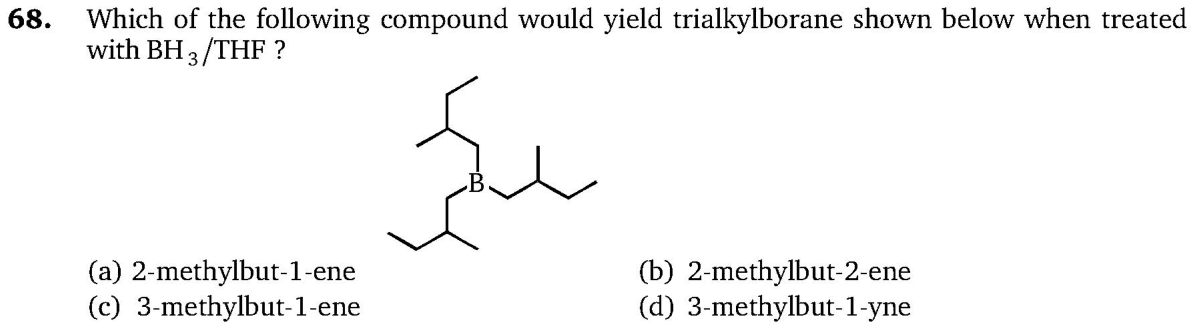
Step 1 - Understand hydroboration: BH3/THF adds across a C=C double bond (hydroboration) in an anti-Markovnikov, syn fashion. The boron attaches to the less substituted carbon of the alkene. Step 2 - Analyze the trialkylborane product: The boron bears three identical alkyl groups. Each alkyl group attached to boron is a 2-methylbutyl group: -CH2-CH(CH3)-CH2-CH3. The boron is on the terminal (primary) carbon, and the methyl branch is on C2 of the chain. Step 3 - Work backward from the product: If boron ends up on the terminal CH2 (C1) and the branch (CH3) is at C2, the alkene precursor must have been CH2=C(CH3)-CH2-CH3, which is 2-methylbut-1-ene. In 2-methylbut-1-ene, the double bond is between C1 and C2, with a methyl substituent at C2. BH3 adds boron to the less hindered C1 (anti-Markovnikov), giving -CH2-CH(CH3)-CH2-CH3 attached to boron — exactly the observed 2-methylbutyl group. Step 4 - Verify with other options: - (b) 2-methylbut-2-ene: double bond between C2 and C3; hydroboration would give boron at C2 or C3, producing a secondary alkyl group — not a primary 2-methylbutyl group. - (c) 3-methylbut-1-ene: CH2=CH-CH(CH3)-CH3; anti-Markovnikov addition puts B at C1, giving -CH2-CH2-CH(CH3)-CH3, a 3-methylbutyl (isopentyl) group — the branch is at C3, not C2. - (d) 3-methylbut-1-yne: an alkyne; hydroboration of alkynes gives vinylboranes, not trialkylboranes under standard BH3 conditions. Step 5 - Conclusion: Only 2-methylbut-1-ene gives the 2-methylbutyl group at boron upon hydroboration, yielding tri(2-methylbutyl)borane. Therefore, the correct answer is B.