See image — Hydrocarbons Chemistry Question
Question
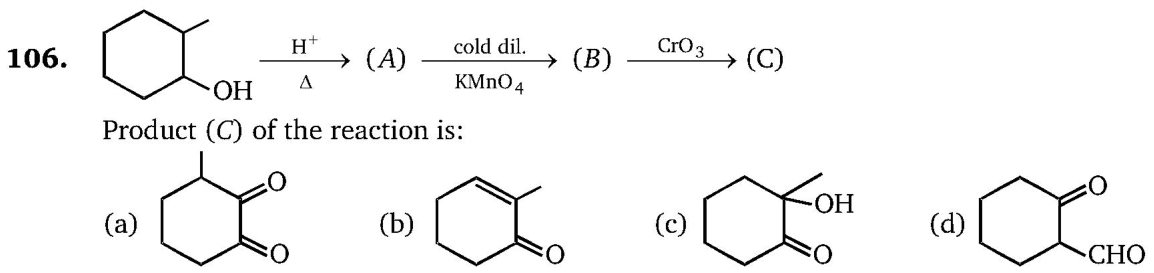
See image
💡 Solution & Explanation
Step 1 - Identify the starting material: The starting material is 2-methylcyclohexan-1-ol (a cyclohexane ring bearing a methyl group and a hydroxyl group on adjacent carbons, specifically 1-methyl-2-hydroxycyclohexane or equivalently 2-methylcyclohexanol). Step 2 - Reaction with H+/Delta to give (A): Acid-catalyzed dehydration of 2-methylcyclohexanol under heat. The elimination of water from 2-methylcyclohexanol follows Zaitsev's rule. The major product is 1-methylcyclohex-1-ene (the more substituted alkene), where the double bond is between C1 and C2 with the methyl group on C1. Thus (A) = 1-methylcyclohex-1-ene (also written as 3-methylcyclohexene depending on numbering, but the key feature is a trisubstituted endocyclic double bond adjacent to the methyl-bearing carbon). Step 3 - Reaction with cold dilute KMnO4 to give (B): Cold, dilute KMnO4 is a mild oxidant that performs syn-dihydroxylation of alkenes, converting C=C into a vicinal diol. So (A) = 1-methylcyclohex-1-ene is converted to (B) = 1-methylcyclohexane-1,2-diol (a diol where C1 bears the methyl group and OH, and C2 bears an OH). Step 4 - Reaction with CrO3 to give (C): CrO3 is a strong oxidizing agent. It oxidizes secondary alcohols to ketones and primary alcohols to carboxylic acids (or aldehydes under controlled conditions). In (B), C1 has a methyl group and an OH (this is a tertiary carbon? No: C1 in the ring has two ring carbons, one methyl, and one OH — that makes it a tertiary alcohol, which CrO3 cannot easily oxidize). C2 has an OH with two ring carbons and one H — that is a secondary alcohol, which CrO3 oxidizes to a ketone. Therefore CrO3 oxidizes the secondary -OH at C2 to a ketone, while the tertiary -OH at C1 remains (tertiary alcohols are not oxidized by CrO3). The product (C) is 1-hydroxy-1-methylcyclohexan-2-one, i.e., a cyclohexanone ring with a methyl group and hydroxyl group both on C1 (the carbon adjacent to the carbonyl). This matches option (c): 2-hydroxy-2-methylcyclohexan-1-one (cyclohexane ring with =O at C1 and OH + methyl at C2). Why other options fail: - (a) A 1,2-diketone product would require oxidation of the tertiary alcohol, which does not occur with CrO3 under normal conditions. - (b) An enone (3-methylcyclohex-2-en-1-one) would require dehydration after oxidation, which is not part of the reaction sequence here. - (d) A CHO (aldehyde) side product would require a primary alcohol intermediate, which is not present here. Therefore, the correct answer is C.