See image — Hydrocarbons Chemistry Question
Question
See image
💡 Solution & Explanation
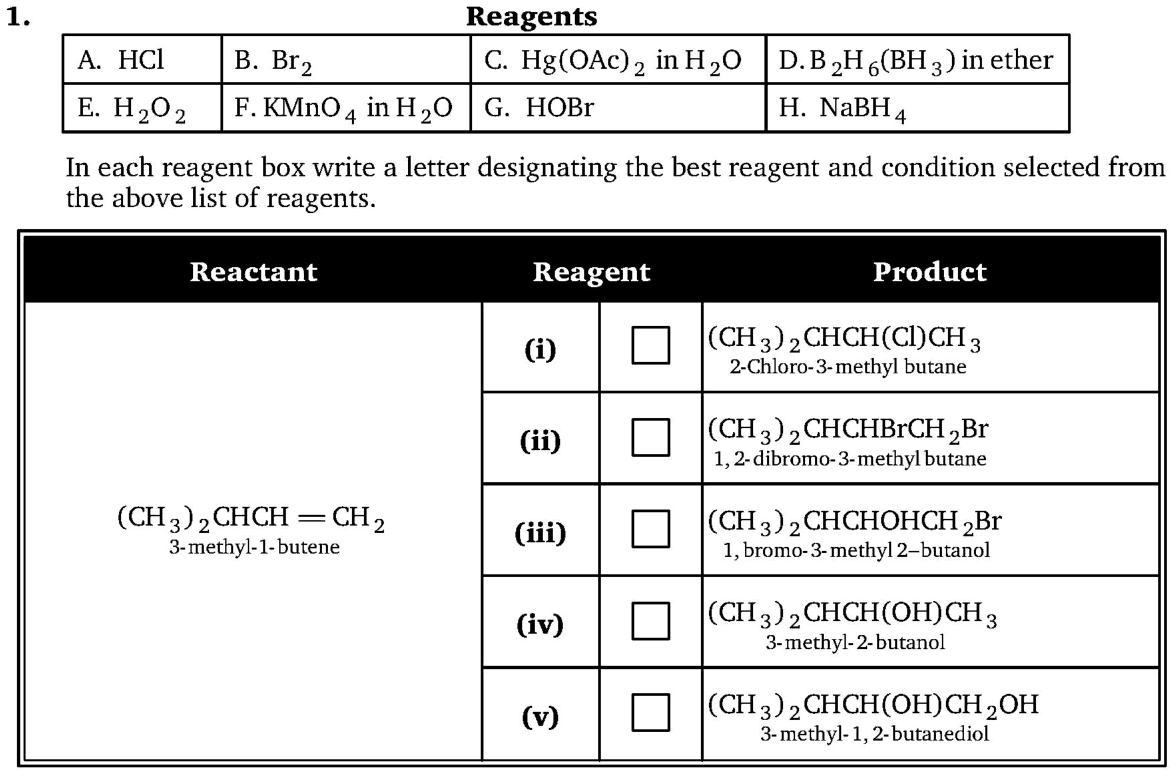
The reactant is 3-methyl-1-butene: (CH3)2CH-CH=CH2. We analyze each product to determine which reagent produces it. (i) Product: (CH3)2CHCH(Cl)CH3 — 2-Chloro-3-methylbutane Concept: HX addition to an alkene follows Markovnikov's rule. HCl adds across CH=CH2 with H going to the terminal carbon (CH2) and Cl going to the internal carbon (CH), giving the Markovnikov product. This gives (CH3)2CH-CH(Cl)-CH3. Reagent: A (HCl) (ii) Product: (CH3)2CHCHBrCH2Br — 1,2-dibromo-3-methylbutane Concept: Br2 adds across a double bond via anti addition (bromonium ion mechanism), placing one Br on each carbon of the double bond. Addition of Br2 to (CH3)2CH-CH=CH2 gives (CH3)2CH-CHBr-CH2Br. Reagent: B (Br2) (iii) Product: (CH3)2CHCH(OH)CH2Br — 1-bromo-3-methyl-2-butanol Concept: HOBr (hypobromous acid) adds to the alkene in an anti-Markovnikov fashion for OH, or more precisely via a bromonium ion intermediate where water attacks the more substituted carbon (Markovnikov-like for OH placement). HOBr addition places OH on the more substituted internal carbon and Br on the terminal carbon, giving (CH3)2CH-CH(OH)-CH2Br. Reagent: G (HOBr) (iv) Product: (CH3)2CHCH(OH)CH3 — 3-methyl-2-butanol Concept: Oxymercuration-demercuration using Hg(OAc)2 in H2O followed by reduction (NaBH4 is step 2, but the key step listed is Hg(OAc)2 in H2O) gives Markovnikov addition of water without rearrangement. OH adds to the more substituted carbon (C-2 of the original alkene, which is C-4 counting from the isopropyl end), yielding (CH3)2CH-CH(OH)-CH3. Reagent: C (Hg(OAc)2 in H2O) (v) Product: (CH3)2CHCH(OH)CH2OH — 3-methyl-1,2-butanediol Concept: KMnO4 in H2O (cold, dilute) performs syn-dihydroxylation of the double bond, adding two OH groups across the double bond to give a 1,2-diol. Addition across CH=CH2 gives (CH3)2CH-CH(OH)-CH2OH. Reagent: F (KMnO4 in H2O) Why other options fail: - D (B2H6/BH3 in ether) would give anti-Markovnikov alcohol after oxidation (hydroboration-oxidation), not applicable here as a single reagent for these products. - E (H2O2) is used as the oxidation step in hydroboration, not standalone. - H (NaBH4) reduces carbonyl groups, not applicable to alkene addition directly. Therefore, the correct answer is {"i": "A", "ii": "B", "iii": "G", "iv": "C", "v": "F"}.