See image — Reaction Mechanism Chemistry Question
Question
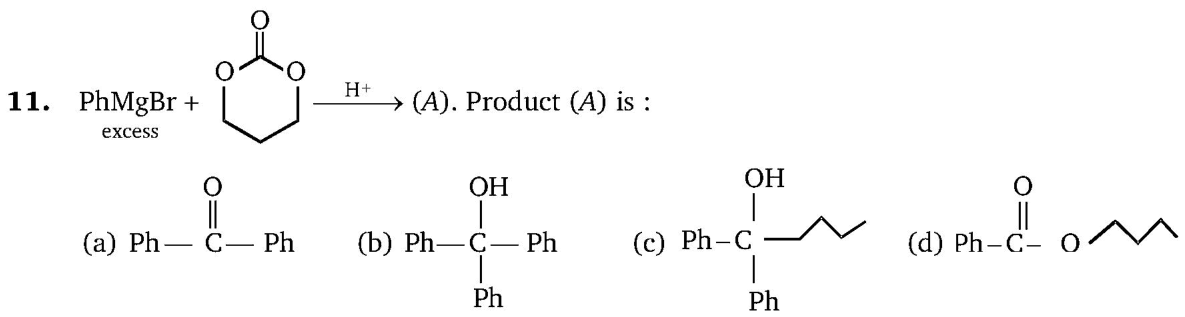
See image
💡 Solution & Explanation
Concept: Grignard reagents react with esters (including cyclic carbonates) in a stepwise fashion. With excess Grignard reagent, the reaction proceeds through two nucleophilic addition steps. Step 1 - Identify the electrophile: The cyclic compound shown is 1,3-dioxan-2-one (trimethylene carbonate), a six-membered cyclic carbonate. The carbonyl carbon is flanked by two oxygen atoms, making it an ester-like (actually a carbonate) electrophile. Step 2 - First equivalent of PhMgBr attacks the carbonyl carbon of the cyclic carbonate. This opens the ring via tetrahedral intermediate, releasing one alkoxide and generating an ester intermediate (a hydroxy ester or ring-opened carbonate that loses CO2 or forms a phenyl ester with a propanol tether). More precisely, ring opening of the cyclic carbonate by PhMgBr gives, after the tetrahedral intermediate collapses, a phenyl ester with a 3-hydroxypropyl group: Ph-C(=O)-O-(CH2)3-OH (or its magnesium salt form), along with expulsion of one -O- as alkoxide. Actually, the cyclic carbonate opens to give Ph-CO-O-(CH2)3-OMgBr, which is a phenyl ester. Step 3 - Second equivalent of PhMgBr (excess) attacks the ester carbonyl (Ph-C(=O)-O-) of this intermediate. A ketone (benzophenone, Ph-C(=O)-Ph) would form transiently after loss of the alkoxide, but with excess PhMgBr, benzophenone is immediately attacked by a third equivalent. Step 4 - Third equivalent of PhMgBr attacks the ketone (benzophenone) to give a tertiary alkoxide: Ph3C-OMgBr. Step 5 - Acidic workup (H+) protonates the alkoxide to give triphenylmethanol: Ph3C-OH. Why other options fail: (a) Benzophenone Ph-C(=O)-Ph would only form if exactly 2 equivalents were used and the reaction were stopped; with excess PhMgBr, benzophenone is further attacked. (c) Ph-C(OH)(Ph)-propyl would result if only one Ph group were added to a non-phenyl ketone; this doesn't match the carbonate substrate with excess PhMgBr. (d) Propyl benzoate Ph-C(=O)-O-propyl is an intermediate that forms after ring opening, but excess PhMgBr reacts further with this ester. With excess PhMgBr (3 equivalents consumed total), the final product after acidic workup is triphenylmethanol: Ph3C-OH. Therefore, the correct answer is B.