See image — Amines Chemistry Question
Question
See image
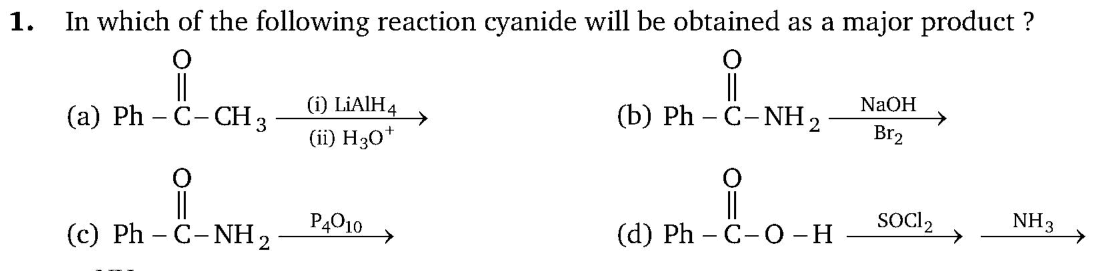
💡 Solution & Explanation
Concept: A nitrile (cyanide, R-C≡N) can be formed by dehydration of a primary amide using a strong dehydrating agent. Step 1 - Analyze each option: Option (a): Ph-C(=O)-CH3 treated with (i) LiAlH4 then (ii) H3O+. LiAlH4 reduces a ketone to a secondary alcohol. Product is Ph-CH(OH)-CH3 (1-phenylethan-1-ol). No nitrile formed. Option (b): Ph-C(=O)-NH2 (benzamide) treated with NaOH and Br2. This is the Hofmann bromamide (Hofmann rearrangement) reaction. The primary amide loses one carbon as CO2 and the product is a primary amine: Ph-NH2 (aniline). No nitrile formed. Option (c): Ph-C(=O)-NH2 (benzamide) treated with P4O10 (phosphorus pentoxide/phosphorus(V) oxide). P4O10 is a powerful dehydrating agent. It dehydrates a primary amide by removing water (H2O) from R-C(=O)-NH2 to give R-C≡N (nitrile/cyanide). Therefore, Ph-C(=O)-NH2 + P4O10 → Ph-C≡N (benzonitrile) + H2O. This produces a nitrile (cyanide) as the major product. Option (d): Ph-C(=O)-OH treated with SOCl2 gives Ph-C(=O)-Cl (benzoyl chloride), then with NH3 gives Ph-C(=O)-NH2 (benzamide). The final product is an amide, not a nitrile. Step 2 - Conclusion: Only option (c) produces a nitrile (cyanide) as the major product via dehydration of benzamide using P4O10. Why other options fail: (a) gives secondary alcohol, (b) gives primary amine via Hofmann rearrangement, (d) gives amide as final product. Therefore, the correct answer is C.