See image — Hydrocarbons Chemistry Question
Question
See image
💡 Solution & Explanation
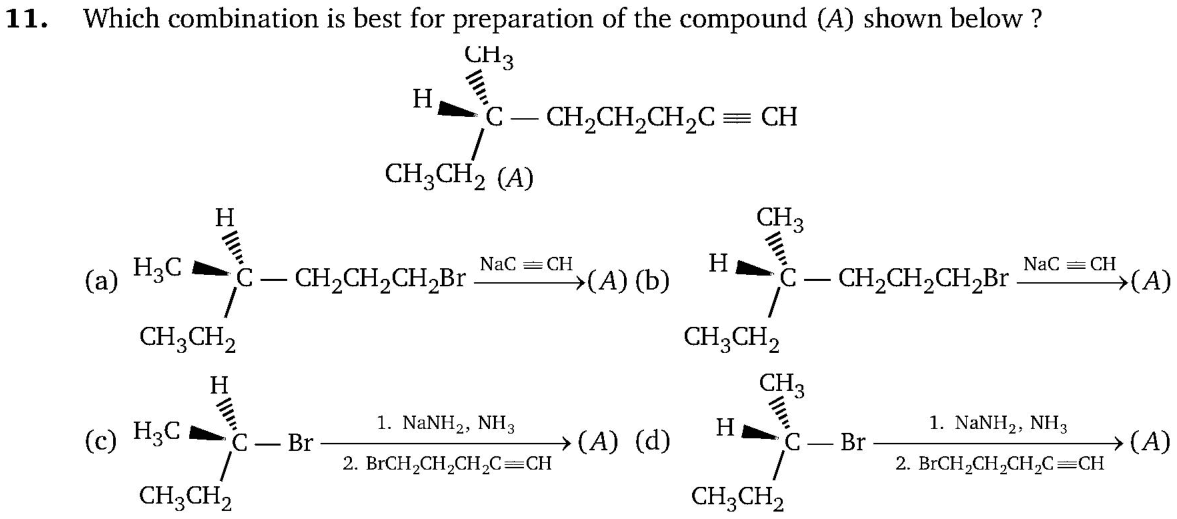
Step 1 - Identify the target molecule (A): Compound (A) is a terminal alkyne: the central stereogenic carbon bears CH3 (wedge up), H (bold wedge forward), an ethyl group (CH3CH2, going down), and a butynyl chain (-CH2CH2CH2C≡CH). The stereochemistry shows CH3 on a bold wedge and H on a bold wedge in option (b)'s starting material matching compound (A). Step 2 - Analyze the reaction strategy: Options (a) and (b) use SN2 alkylation: a primary alkyl bromide (-CH2CH2CH2Br) attached to the chiral center is displaced by sodium acetylide (NaC≡CH) to install the terminal alkyne. In SN2, the reaction occurs at the primary carbon of the side chain (not at the stereocenter), so the configuration at the chiral center is RETAINED. Options (c) and (d) involve deprotonating a terminal alkyne with NaNH2/NH3 and then alkylating with BrCH2CH2CH2C≡CH. However, the starting material has Br directly on the chiral (secondary) carbon. SN2 at a secondary carbon would be slow and would INVERT the stereocenter, making stereochemical control poor. This approach is less suitable. Step 3 - Determine correct stereochemistry in options (a) vs (b): In compound (A), CH3 is on a bold wedge (coming toward viewer) and H is also shown on a bold wedge. Looking at option (a): H3C is on a regular wedge and H is on bold wedge — the methyl and hydrogen spatial arrangement differs from (A). In option (b): CH3 is on a bold wedge (same as in A) and H is on a bold wedge, with CH2CH2CH2Br and CH3CH2 in the same arrangement as in (A). The SN2 reaction of NaC≡CH on the primary bromide does not disturb the stereocenter, so the configuration is preserved. The starting material in (b) already has the correct stereochemistry matching (A) after the acetylide replaces Br on the terminal primary carbon. Step 4 - Why (a) fails: Option (a) has H3C on a regular wedge rather than a bold wedge, indicating a different stereochemical arrangement at the chiral center compared to (A). The product would be the wrong enantiomer/diastereomer. Step 5 - Why (c) and (d) fail: These routes attempt SN2 at a secondary carbon (the chiral center bears Br), which is sterically hindered, proceeds with inversion, and gives poor yields. They are not the best combination. Therefore, the correct answer is B.