See image — Isomerism and Stereochemistry Chemistry Question
Question
See image
💡 Solution & Explanation
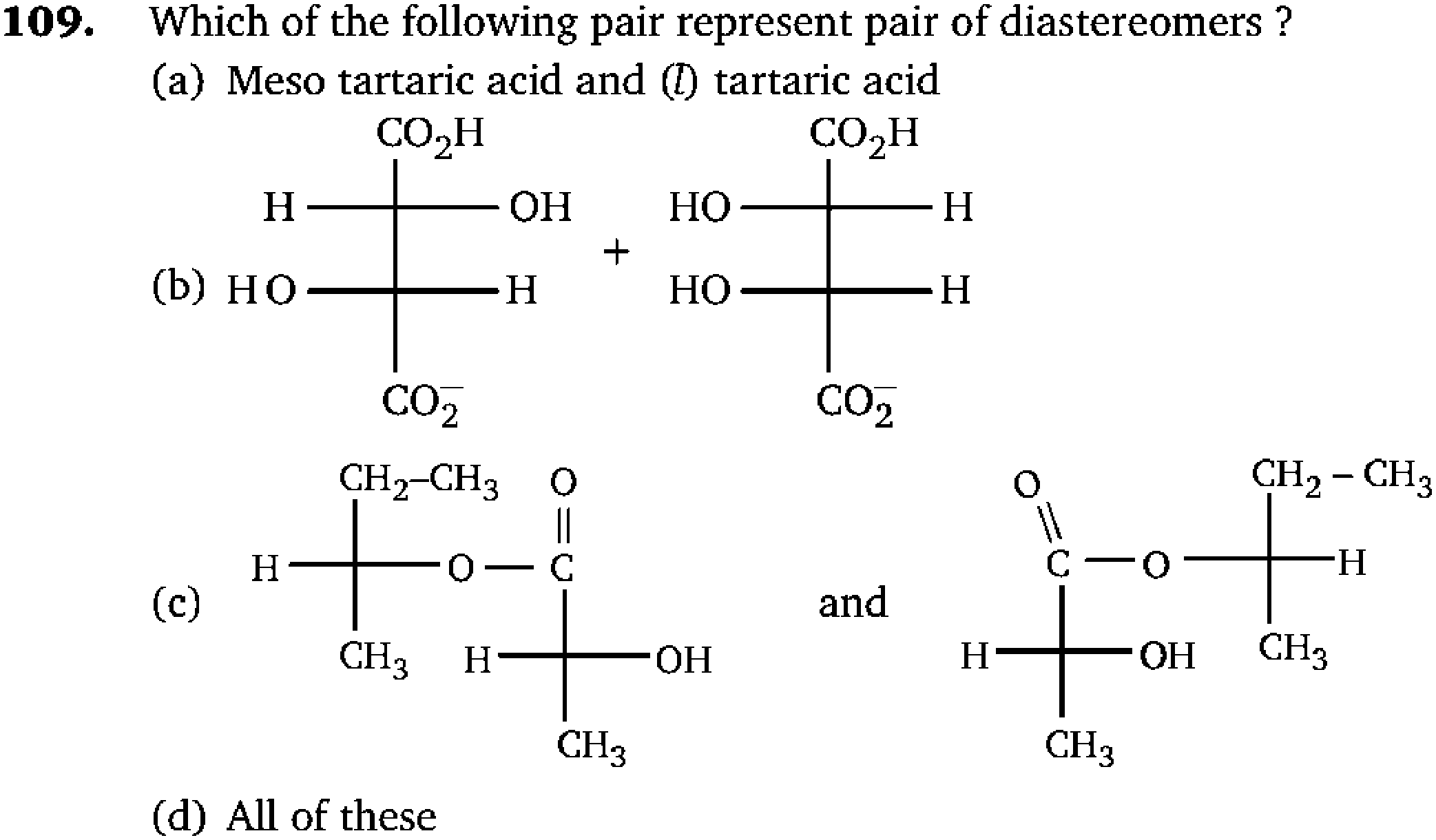
Diastereomers are stereoisomers that are not mirror images of each other. They have the same molecular formula and connectivity but differ in the spatial arrangement of groups at one or more (but not all) stereocenters. Step 1 – Option (a): Meso tartaric acid and (l) tartaric acid. Meso tartaric acid has the configuration (2R,3S) and is achiral due to an internal plane of symmetry. (l)-tartaric acid has the configuration (2S,3S). These two compounds are stereoisomers with the same molecular formula and connectivity, they are not mirror images of each other (the mirror image of meso is itself; the mirror image of (2S,3S) is (2R,3R)), so meso tartaric acid and (l) tartaric acid are diastereomers. Option (a) is correct. Step 2 – Option (b): The two structures shown in the Fischer projections. Left structure: C2 has H on left, OH on right (R configuration); C3 has HO on left, H on right (S configuration) → (2R,3S) = meso tartaric acid (as monoanion or partial ionization form). Right structure: C2 has HO on left, H on right (S); C3 has HO on left, H on right (S) → (2S,3S) = (l)-tartaric acid form. These are non-mirror-image stereoisomers, i.e., diastereomers. Option (b) is correct (and is essentially a structural representation of option (a)). Step 3 – Option (c): The two ester structures shown. Both structures represent an ester of lactic acid (2-hydroxypropanoic acid) with a chiral alcohol (1-methylpropan-1-ol or sec-butanol equivalent), or more precisely an ester where both the acid portion and alcohol portion each have one stereocenter. Examining the configurations: the left structure has specific R/S assignments at both stereocenters, and the right structure differs at one (but not both) stereocenter. Since the two structures are stereoisomers that are not mirror images of each other (they differ at one stereocenter while sharing the same at another, or have configurations that make them non-enantiomeric), they constitute a pair of diastereomers. Option (c) is correct. Step 4 – Since options (a), (b), and (c) all represent pairs of diastereomers, the answer is (d) All of these. Therefore, the correct answer is D.