See image — IUPAC and Nomenclature Chemistry Question
Question
See image
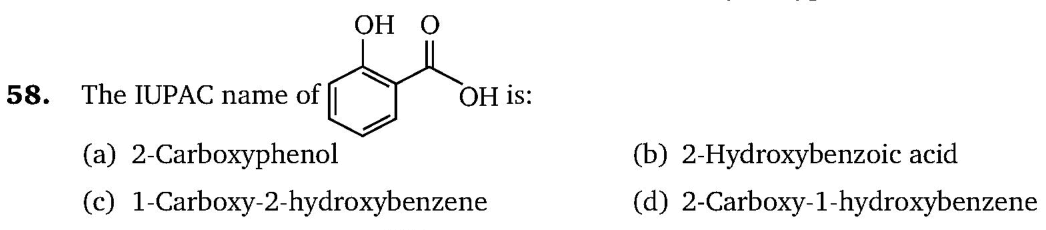
💡 Solution & Explanation
Concept: IUPAC nomenclature for aromatic compounds with multiple substituents requires identifying the principal characteristic group to determine the parent chain/ring name, then numbering to give the principal group the lowest locant. Step 1: Identify the functional groups present. The structure shows a benzene ring with two substituents: a hydroxyl group (OH) and a carboxylic acid group (COOH) in ortho (1,2) positions relative to each other. Step 2: Determine the principal characteristic group. In IUPAC nomenclature, carboxylic acid (-COOH) has higher seniority than alcohol/phenol (-OH). Therefore, the carboxylic acid group determines the parent name. Step 3: Name the parent structure. A benzene ring with a -COOH group as the principal characteristic group is named 'benzoic acid'. The carbon bearing the -COOH group is C-1 by definition. Step 4: Locate the substituent. The -OH group is on the carbon adjacent (ortho) to the -COOH group, which is C-2. Therefore, the -OH is a hydroxy substituent at position 2. Step 5: Assemble the name. The compound is 2-hydroxybenzoic acid. Why other options fail: - (a) 2-Carboxyphenol: This treats phenol (OH) as the parent, but COOH has higher seniority than OH, so benzoic acid should be the parent, not phenol. - (c) 1-Carboxy-2-hydroxybenzene: This uses substitutive nomenclature on benzene treating both groups as substituents, which is not preferred when a principal characteristic group like COOH can define the parent name as benzoic acid. - (d) 2-Carboxy-1-hydroxybenzene: Same issue as (c), and additionally gives OH the C-1 position, which is incorrect since COOH should be at C-1. Therefore, the correct answer is B.