See image — Hydrocarbons Chemistry Question
Question
See image
💡 Solution & Explanation
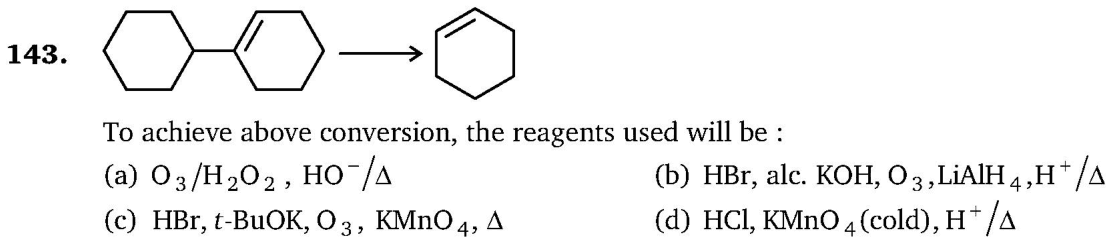
Step 1 – Identify the starting material and product. Starting material: cyclohexylidene cyclohexane (an exocyclic alkene where two cyclohexane rings share a C=C double bond, i.e., the double bond is between C1 of one ring and C1 of the other ring). Product: cyclohexene (one cyclohexane ring containing one endocyclic C=C double bond). Step 2 – Plan the retrosynthetic strategy. We need to (a) break one of the cyclohexane rings open or, more precisely, cleave the molecule so that only one cyclohexene remains. The exocyclic double bond must be cleaved and one ring must be destroyed while leaving the other ring intact with a double bond introduced inside it. Step 3 – Evaluate option B: HBr, alc. KOH, O3, LiAlH4, H+/Delta. Step 3a – HBr addition to the exocyclic double bond (Markovnikov or simply adding across the C=C): The exocyclic alkene reacts with HBr. Because the two carbons of the double bond are both ring carbons (each is tertiary in context), HBr adds to give a bromine on one of the ring carbons. Specifically, addition of HBr gives 1-bromo-1-cyclohexyl-cyclohexane (bromide at the sp2 carbon of one ring, with the other ring now as a substituent). Step 3b – alc. KOH (alcoholic KOH, i.e., E2 elimination): Treatment with alc. KOH promotes E2 elimination of HBr, but under these bulky/alcoholic conditions the less substituted (endocyclic) alkene is not necessarily the product; however, elimination occurs to give an endocyclic double bond in one of the rings, generating 1-cyclohexenyl-cyclohexane (the double bond moves into the ring — a cyclohexene ring still bearing a cyclohexyl substituent, or alternatively cyclohexylidenecyclohexane geometry changes). More precisely, alc. KOH causes elimination to place the double bond endocyclically: giving 1-(cyclohex-1-en-1-yl)cyclohexane. Step 3c – O3 (ozonolysis): Ozonolysis of the endocyclic double bond in the cyclohexene ring cleaves it, opening that ring and giving a dialdehyde/diketone fragment plus the intact cyclohexanone/cyclohexane portion. Specifically, ozonolysis of the trisubstituted endocyclic double bond of 1-(cyclohex-1-en-1-yl)cyclohexane followed by reductive workup (implied by LiAlH4 in the next step) gives a keto-aldehyde open-chain tethered to the other cyclohexane ring — effectively cleaving the ring that had the double bond into an open-chain dicarbonyl, while the other cyclohexane ring bearing a carbonyl (ketone) remains. Step 3d – LiAlH4, H+: Reduction of the carbonyl groups to alcohols, then protonation. Step 3e – H+/Delta (acid and heat): Protonation and heating causes dehydration of the alcohol and intramolecular cyclization or simply dehydration, ultimately regenerating cyclohexene from the ring that was not cleaved. The net result of the sequence HBr → alc. KOH → O3 → LiAlH4 → H+/Delta is conversion of cyclohexylidenecyclohexane into cyclohexene, by selectively cleaving one ring and regenerating a ring with an endocyclic double bond from the remaining fragment. Step 4 – Why other options fail. (a) O3/H2O2 is an oxidative ozonolysis workup that would give carboxylic acids/ketones, not cyclohexene; HO-/Delta cannot reconstruct the cyclohexene ring from those fragments. (c) t-BuOK after HBr would also give an endocyclic alkene but KMnO4 (hot oxidant) would further oxidize rather than cleanly give cyclohexene. (d) HCl and cold KMnO4 (dihydroxylation) do not lead to the required cleavage and ring reduction sequence. Therefore, the correct answer is B.